In the blog "Strike the Root", the author Carpe Libertatem wrote Diffusion and Confusion describing the difficulty in determining who, exactly, is responsible for violating the rights of the people in the United States today.
The problem is that the first line agents, the police for example, are only following orders and did not originate the command that ultimately results in a violation of rights. Their supervisors only gave the orders and neither originated the laws that resulted in the orders nor actually implemented the orders. The ultimate source of the laws, the politicians, neither give the orders nor obey the orders.
All three links in the chain have found a way to absolve themselves of responsibility. All three of them are invoking a form of the Nuremberg defense.
Carpe Libertatem ultimately condemned Joseph Stack as a murderer because the person he killed was not the actual aggressor. He's right, and he's wrong. Vernon Hunter was not personally threatening Joseph Stack, but Vernon Hunter was a piece of the machine that was threatening Joseph Stack.
Killing of government agents is not only wrong, it's a bad idea. But it is time to stop accepting the Nuremberg defense. When agents of the government try to use it, they should be called on it every time.
It is a good idea to refuse to deal with anybody in the enforcement branch, from the making of laws to issuing of orders to implementing of orders, as if the Nuremberg defense is their default mode unless they clearly indicate otherwise in some manner, such as joining Oath Keepers. Any politician, administrator, or officer who doesn't indicate a repudiation of the Nuremberg Defense should be treated as a potential but not realized threat and people should have as little to do with them as possible.
Saturday, April 17, 2010


Friday, April 09, 2010
Who will be betrayed?
Now that healthcare reform has passed, the onerous task of finding out what is actually in it has begun. But some parts are already known. There is a provision that people must either carry insurance or pay a fine, but the fine is lower than the price of an insurance policy. This is coupled with a prohibition against denying anyone who has a pre-existing condition.
Politicians are convinced this will cause everyone to carry insurance for their own good. Economists are convinced that given the nature of the incentives people will only carry insurance when they actually need it and will prefer to pay the fine the rest of the time. Politicians are shocked when economists tell them that people may deliberately opt to not carry insurance given the nature of the incentives.
The situation is completely unsustainable. One way or another something has to give. The question is what exactly will give? As long as the situation continues as designed then the insurance companies will lose money. Who exactly is congress planning on betraying?
At first people will pay the fines rather than carry the insurance. At first the insurance companies will lose money. Then they will petition congress to raise the fine above the cost of an insurance policy. Then one of two things will happen.
One option is that congress will comply with the wishes of the insurance companies and raise the fines. This will cause people to actually try to contest the validity of the fines in court. This will lead to the argument that by paying the fines before they went up people had agreed to the validity of the fines. Those who had not contested the fines in previous years will have their standing questioned. Perhaps congress will, when raising the fines, enact legislation that anyone who had willingly paid the fine in previous years without complaint have no standing in the future.
The other option is that congress will keep the fines low in spite of the complaints of the insurance companies. Perhaps, adding insult to injury, they will raise the fines but still keep them lower than the cost of an insurance policy, directing yet more money that “should” have been going to the insurance companies to the government. This will bankrupt any company that is offering health insurance and direct even more people to a government healthcare plan.
Neither option is attractive, and it is difficult to say which option is worse. But given the current situation as designed in the healthcare reform bill those are the two possible futures.
Politicians are convinced this will cause everyone to carry insurance for their own good. Economists are convinced that given the nature of the incentives people will only carry insurance when they actually need it and will prefer to pay the fine the rest of the time. Politicians are shocked when economists tell them that people may deliberately opt to not carry insurance given the nature of the incentives.
The situation is completely unsustainable. One way or another something has to give. The question is what exactly will give? As long as the situation continues as designed then the insurance companies will lose money. Who exactly is congress planning on betraying?
At first people will pay the fines rather than carry the insurance. At first the insurance companies will lose money. Then they will petition congress to raise the fine above the cost of an insurance policy. Then one of two things will happen.
One option is that congress will comply with the wishes of the insurance companies and raise the fines. This will cause people to actually try to contest the validity of the fines in court. This will lead to the argument that by paying the fines before they went up people had agreed to the validity of the fines. Those who had not contested the fines in previous years will have their standing questioned. Perhaps congress will, when raising the fines, enact legislation that anyone who had willingly paid the fine in previous years without complaint have no standing in the future.
The other option is that congress will keep the fines low in spite of the complaints of the insurance companies. Perhaps, adding insult to injury, they will raise the fines but still keep them lower than the cost of an insurance policy, directing yet more money that “should” have been going to the insurance companies to the government. This will bankrupt any company that is offering health insurance and direct even more people to a government healthcare plan.
Neither option is attractive, and it is difficult to say which option is worse. But given the current situation as designed in the healthcare reform bill those are the two possible futures.
Friday, April 02, 2010
Tribesman, Barbarian, Citizen … and Libertarian
It is always risky to take a work developed by someone else and try to discover something the original author has not yet developed. William Lind developed the theory about the four generations of warfare, and has since received emails describing a tentative fifth stage of warfare that he reports isn’t actually a fifth stage. But then there are times when building up on the existing framework does indeed add something new, such as when William Lind discovered the fourth generation in the first place.
Jerry Pournelle created a theoretical framework to describe three different stages of cultural advancement. He left open the possibility of discovering what might be the fourth stage of cultural development based upon how the different stages react to each other when the come into contact.
The first described is the interaction between the Tribesman and the Barbarian.
The next thing he describes is what happens when a Barbarian meets a Citizen.
Finally, almost as an afterthought, he describes what happens when Tribesmen meet Citizens.
He includes two references to describe what the next phase of cultural development would be within the framework of Tribesman, Barbarian, and Citizen.
The key point to notice is that in any given stage, the immediately later stage will look distressingly like the immediately previous stage. To the Barbarian, the Citizen appears distressingly like the Tribesman. The relationship is superficial, as the citizen takes orders not because he is "not a man" but because after having discovered individualism (and immediately overdoing it as the Barbarian does) they have discovered cooperation. The fact that Tribesmen and Citizens are alien to each other is revealed in the way they interact in the description provided by Mr. Pournelle.
So, to a Citizen, the next stage will resemble all of the features of Barbarism that the Citizen has outgrown and now finds repulsive. The Citizen views the Barbarian as a criminal who has no respect for other individuals. The extreme individualism of the Barbarian would never respect a contract, would never take orders that he feels contradicts his own desires.
That is how a Citizen would view the next stage. He would view the next stage as criminal, and those in it as individuals who have no respect for social order. And, just as the Citizen superficially resembles the Tribesman, the Citizen’s view of the next stage would be superficially accurate.
Which is why it baffles the Citizen that the Libertarian is stricter in upholding the rights of others and the sanctity of the contract than even the Citizen is, that the Libertarian isn’t a criminal the way a Barbarian is. The Citizen is as baffled by the Libertarian as the Barbarian is baffled by the Citizen.
It should be noted here that "Libertarian" in this context has a much broader definition than agreeing with the platform of the Libertarian Party of the United States. In this context it encompasses many different movements with many different ideas. The common ground in this context is the social outlook that differentiates it from Citizen, Barbarian, or Tribesman.
Just as the Citizen took the lessons of individualism learned by the Barbarian and tempered them with cross-linked cooperation, the Libertarian took the lessons of cooperation and tempered them with a respect for, not just the individual, but each other as individuals. This is fundamentally different from the individualism of the Barbarian, as it respects other individuals as individuals. It is cross-linked cooperative individualism, to stretch the descriptions first described by Mr. Pournelle.
That only leaves, if Libertarianism is indeed the fourth stage of development thus far advanced to by mankind, how Libertarianism views prior stages.
Although the Citizen views the Libertarian as similar to the Barbarian, the Libertarian and the Barbarian do not view each other that way. Just as the Tribesman does not understand the Citizen, the Barbarian does not understand the Libertarian. The Libertarian, completely unorganized, is capable of spontaneous cross-linked cooperation to form an organized defense that strongly resembles that of the Citizen. The Libertarian doesn’t simply take what he wants, but fights fiercely against those who would simply take – and eventually even fights against the Citizen on those same grounds. When the Libertarian does fight the Citizen, it is not for the purpose of looting but to stop looting.
The Libertarian would basically ignore the Tribesman. While a Citizen, having discovered cooperation is eager to share it with everyone whether or not they want it shared, the Libertarian, having discovered that people have a right to be left alone is eager to leave people alone. Since the Tribesman is not a looter the way a Barbarian is, or even the more subtle way the Citizen is, the Libertarian has no reason for conflict.
However, the Tribesman will see the Libertarian as completely and utterly alien, even more so than Barbarians (who merely represent absolute evil) or the Citizen (who represents new replacement traditions). The Libertarian could potentially be new traditions, except that he consistently refuses to take that burden. The Tribesman can try to return the favor and politely ignore the Libertarian, but eventually is forced to adapt and move forward to a new stage whether he likes it or not. The Libertarian would try to treat individual Tribesmen as equals, but just as with the Citizen and the Tribesman not knowing he's a man, the Tribesman doesn't know he's an individual.
Fortunately for the Libertarian, according to Jerry Pournelle, any time a later stage encounters an earlier stage, it spells doom for the earlier stage. Libertarianism was birthed with John Locke, midwifed by Thomas Jefferson, and then brought to maturity by Lysander Spooner, Friedrich von Hayek, Murray Rothbard, and other libertarian philosophers. And by their work the idea that people should belong to each other is doomed.
Jerry Pournelle created a theoretical framework to describe three different stages of cultural advancement. He left open the possibility of discovering what might be the fourth stage of cultural development based upon how the different stages react to each other when the come into contact.
The first described is the interaction between the Tribesman and the Barbarian.
When Barbarism first arises in any area, Tribalism is doomed. The two are mutually exclusive, and there is no possible "peaceful coexistence" between them. To the Tribesman, the Barbarian is Evil Incarnate; the Barbarian has utterly rejected all Good, Moral, and Ethical values. He has rejected the Sacred Traditions, and glories in his absolute defiance of them. He blasphemes not casually, but as a way of life.
To the Barbarians, the Tribesman is a slave, a spineless, gutless coward, a disgrace to human shape. He has no self-respect, no courage to take a risk, no faith in himself. He doesn't respect himself, or any man. He won't fight for any reward, no matter how great and shining! He's a stupid, lazy slug, a disgrace to humanity.
The Tribesman won't fight for reward, he won't take a risk for great gain--because that is not in the Traditions. A Tribesman can't fight an enemy tribe for that enemy tribe's land; his tribal traditions refer to his tribe's land. If he did take the neighboring tribe's land . . . there would be no traditions to tell what to do with it. It would, in fact, be a Change, and therefore Evil.
The "battles" between two ritual-taboo tribes, anthropologists have long since observed, are practically pure rituals, and actually have a vanishingly small casualty rate. Not greatly different--for all the use of spears!--than in modern college football clashes. The spears are hurled while at a range so extreme that it's sheer accident if someone gets hurt.
When Barbarism appears--that situation changes in a hurry. The Barbarian army isn't going through a ritual; they're out for blood and loot. They don't have traditions as guides, nor as limiting fences about them.
The next thing he describes is what happens when a Barbarian meets a Citizen.
When the Barbarian encounters Civilization, therefore, he is going to be enormously confused and baffled. The Barbarians of North Europe, meeting the Citizens of the Roman Republic, were meeting men who allowed others to order them about, to tell them what to do and when to do it. Who obeyed commands they didn't, themselves, agree with. Obviously, a pack of servile slaves!
But these cowardly Roman Legionnaires, for some incomprehensible reason, did not collapse in battle. These Legionnaires, who had no self-respect, who did not fight man-to-man, but used short swords so that no one of them could say, when he returned home, "I killed Urhtoth!" but only, "I am a member of the Fourth Legion,"--these Romans strangely didn't flee before the fiercest Barbarian charges.
To the Barbarians, the Citizen shows the symptoms of all the things the Barbarian rejects as vile and degrading--the essence of cowardice. The Citizen yields his will to the demands of others. He allows himself to be limited, and allows himself to be compelled against his own desires.
To the Barbarian, the Citizen shows the same loathsome abnegation that the Tribesman does.
Which makes it all the more incomprehensible that these sniveling Citizens win battle after battle. They who have sacrificed their Manhood, have given up their right to individual dignity, somehow prove able to fight like maddened demons!
Finally, almost as an afterthought, he describes what happens when Tribesmen meet Citizens.
Notice that the root philosophy of the ritual-taboo tribesman is such that it is inherently impossible to cooperate with him in establishing a colony. So long as the natives are true Tribesmen, Change is Evil--and the colonists are introducing change. There is no such thing as "a good change" in a pure-tradition system: "Change is Evil; Evil is Change."
More immediately, the Tribesman's sense of security stems entirely from having a sure source of Answers. The Tribesman has no answers himself, and has no sense that he can be a source of answers. His sense of security, his defense against the Unknown, is a Source of Answers. He expects to be told what to do, when, and how; if his Tribal Traditions don't do so, then some other source of Answers must. He has no expectation or desire to be responsible for his own acts; that way lies the terror of the Unknown.
If some colonist comes in and overthrows the Tribal Traditions--then the Colonist must be the Source of Answers. The Tribesman cannot cooperate on a man-to-man basis with the colonist, no matter how the colonist may seek to establish such a system. The Tribesman doesn't know he's a man; he knows only that he's a Unit of the System--that he has to be a unit of some system.
You can lead a horse to water, but you can't make him drink. And you can lead a Tribesman to Liberty . . . but you can't make him free.
He includes two references to describe what the next phase of cultural development would be within the framework of Tribesman, Barbarian, and Citizen.
At each stage of cultural evolution, the preceding stage appears loathsome . . . and the succeeding stage appears to partake of those same loathsome characteristics.
As a rough guess, it's highly probable that the next stage of cultural evolution will appear, to us, to be Barbarism, and be a horrible, degenerate, loathsome system indeed.
Just as the Civil system appears, to the Barbarian, to be the Tribal system, in which the individual has no dignity, and a man is not a Man, for he lacks the courage to express his individual worth and will.
. . .
It's also interesting to wonder what will happen if we go in to some planet, and find what seems to be a Barbarian culture ... which isn't. It would certainly be baffling, and almost certainly be disastrous in a way we cannot dimly imagine.
It would mean the destruction of our very souls. Just as Civilization, by merely contacting Barbarians repeatedly, brings about the corruption and degradation of their dignity, their self-respect--their very souls. And turns them into cowardly, weakened, crawling things that actually cooperate with another human being.
We can't, of course, guess just what form of loathsome corruption of our selves, our dignity, looms before us.
It doesn't really matter; we're going to get it anyway, whether from outside, or from our own unwanted, yet inescapable, evolution.
But we won't like it. Any more than a Tribesman likes becoming that essence of corruption and evil, a Barbarian. Or a Barbarian likes becoming that sniveling thing, a Citizen.
The key point to notice is that in any given stage, the immediately later stage will look distressingly like the immediately previous stage. To the Barbarian, the Citizen appears distressingly like the Tribesman. The relationship is superficial, as the citizen takes orders not because he is "not a man" but because after having discovered individualism (and immediately overdoing it as the Barbarian does) they have discovered cooperation. The fact that Tribesmen and Citizens are alien to each other is revealed in the way they interact in the description provided by Mr. Pournelle.
So, to a Citizen, the next stage will resemble all of the features of Barbarism that the Citizen has outgrown and now finds repulsive. The Citizen views the Barbarian as a criminal who has no respect for other individuals. The extreme individualism of the Barbarian would never respect a contract, would never take orders that he feels contradicts his own desires.
That is how a Citizen would view the next stage. He would view the next stage as criminal, and those in it as individuals who have no respect for social order. And, just as the Citizen superficially resembles the Tribesman, the Citizen’s view of the next stage would be superficially accurate.
Which is why it baffles the Citizen that the Libertarian is stricter in upholding the rights of others and the sanctity of the contract than even the Citizen is, that the Libertarian isn’t a criminal the way a Barbarian is. The Citizen is as baffled by the Libertarian as the Barbarian is baffled by the Citizen.
It should be noted here that "Libertarian" in this context has a much broader definition than agreeing with the platform of the Libertarian Party of the United States. In this context it encompasses many different movements with many different ideas. The common ground in this context is the social outlook that differentiates it from Citizen, Barbarian, or Tribesman.
Just as the Citizen took the lessons of individualism learned by the Barbarian and tempered them with cross-linked cooperation, the Libertarian took the lessons of cooperation and tempered them with a respect for, not just the individual, but each other as individuals. This is fundamentally different from the individualism of the Barbarian, as it respects other individuals as individuals. It is cross-linked cooperative individualism, to stretch the descriptions first described by Mr. Pournelle.
That only leaves, if Libertarianism is indeed the fourth stage of development thus far advanced to by mankind, how Libertarianism views prior stages.
Although the Citizen views the Libertarian as similar to the Barbarian, the Libertarian and the Barbarian do not view each other that way. Just as the Tribesman does not understand the Citizen, the Barbarian does not understand the Libertarian. The Libertarian, completely unorganized, is capable of spontaneous cross-linked cooperation to form an organized defense that strongly resembles that of the Citizen. The Libertarian doesn’t simply take what he wants, but fights fiercely against those who would simply take – and eventually even fights against the Citizen on those same grounds. When the Libertarian does fight the Citizen, it is not for the purpose of looting but to stop looting.
The Libertarian would basically ignore the Tribesman. While a Citizen, having discovered cooperation is eager to share it with everyone whether or not they want it shared, the Libertarian, having discovered that people have a right to be left alone is eager to leave people alone. Since the Tribesman is not a looter the way a Barbarian is, or even the more subtle way the Citizen is, the Libertarian has no reason for conflict.
However, the Tribesman will see the Libertarian as completely and utterly alien, even more so than Barbarians (who merely represent absolute evil) or the Citizen (who represents new replacement traditions). The Libertarian could potentially be new traditions, except that he consistently refuses to take that burden. The Tribesman can try to return the favor and politely ignore the Libertarian, but eventually is forced to adapt and move forward to a new stage whether he likes it or not. The Libertarian would try to treat individual Tribesmen as equals, but just as with the Citizen and the Tribesman not knowing he's a man, the Tribesman doesn't know he's an individual.
Fortunately for the Libertarian, according to Jerry Pournelle, any time a later stage encounters an earlier stage, it spells doom for the earlier stage. Libertarianism was birthed with John Locke, midwifed by Thomas Jefferson, and then brought to maturity by Lysander Spooner, Friedrich von Hayek, Murray Rothbard, and other libertarian philosophers. And by their work the idea that people should belong to each other is doomed.
Saturday, March 27, 2010
Tribesman, Barbarian, and Citizen
In the anthology "The Stars At War, Volume 1, Imperial Stars", assembled in 1986 by Jerry Pournelle, he included an original essay “Tribesman, Barbarian, and Citizen”. It can be read here and it includes some very useful concepts.
The essay's value as a piece of anthropology is as useful as the Social Contract written about by Hobbes and Locke, but just as with the Social Contract it is not in anthropology that it has uses. Like the Social Contract, it is a "useful myth" in which Mr. Pournelle describes three levels of social development that a people go through.
The first is the Tribesman:
The next stage above Tribesman is Barbarian.
He also describes the relationship between Barbarians and Tribesmen. Tribesmen, who view change as violating the traditions and therefore evil, see the Barbarian as evil. Barbarians, who view obeying orders with which one disagrees as spineless and sub-human, sees Tribesmen as being fit only for slavery as they are not human. A Barbarian thinks it pitiful is someone obeys an order with which he disagrees.
Advancing beyond Barbarism, the third stage so far is Civilization.
He spends little time describing the Civil system, and given that it is the current system in the western world there should theoretically be little need to describe it. What he does describe is interactions between Barbarians and Citizens and between Tribesmen and Citizens. In both cases, as with Barbarian and Tribesmen, interaction between a later stage and an earlier stage dooms the earlier stage.
The key question then becomes what happens to a Barbarian who discovers he cannot beat a Civil System from the outside? Doing so from the outside turns the Barbarian into a criminal, as can be discovered from a cursory examination of most true criminals. At one point there was a belief that criminals had insufficient self esteem, but further examination found that many real criminals had excessive self esteem.
A smarter Barbarian would find the Civil system useful, to do from the inside what cannot be done from the outside, to use the system for looting by proxy. The first advantage of this is that it saves the Barbarian from the consequences of criminal activity. The second advantage is that Citizens are conditioned to have a basic respect for order, and thus are much less likely to defend themselves from crimes when committed by the government.
This actually solves one of the biggest riddles of the twentieth century: why did not the German people do more to assassinate Hitler or overthrow his regime? It is because the Germans were a civilized people, raised to have a basic respect for order. Even though they did not like it, the Barbarian Hitler achieved power working inside the system.
If faced with a Barbarian in an alley, a Citizen will fight back. If faced with a Barbarian with a government form, a Citizen is likely to give in and try to work within the system to stop the Barbarian. A stupid Barbarian becomes a criminal; a smart Barbarian becomes a politician.
The essay's value as a piece of anthropology is as useful as the Social Contract written about by Hobbes and Locke, but just as with the Social Contract it is not in anthropology that it has uses. Like the Social Contract, it is a "useful myth" in which Mr. Pournelle describes three levels of social development that a people go through.
The first is the Tribesman:
The Tribal culture--in its never-actually-existent theoretical pure state--is a system of pure ritual and taboo. "Everything that is not forbidden is compulsory." The objectively observable system stems from an unstated philosophy--which is unstated because the Tribesman doesn't know philosophy exists, any more than a dog knows logic exists, or a fish knows that biochemistry exists. The philosophy is, essentially precisely that of the Absolute Totalitarian state . . . minus the familiar dictator. That is, in the Tribe, the individual exists for the service of the state. The individual has no value whatever, save as a replaceable plug-in unit in the immortal, ever-existent machinery-organism of the Tribe. No individual exists as an individual--neither Tribal king nor Tribal slave; each is a unit plugged in--temporarily, for all these units wear out and are discarded in a score or two of years--to the eternal Traditional System of the Tribe. The cells in a living organism wear out and are discarded; the organism is, relatively speaking, immortal. So, in the Tribe, the individual is nothing; the Tribe is eternal.
In return for a practically absolute loss of self-identity, the Tribesman is rewarded with security and peace of mind. The Tribal Traditions have The Answers to all possible real problems; nothing can happen that the Tribal Traditions, in their ancient and time-tested wisdom, have not already solved. There are no doubts; there are answers which involve "these tribesmen must die," but Death is not intolerable. Uncertainty--Doubt--these are the Terrors that live in the Unknown. And against those horrors, the ancient wisdom of the Tribal Traditions stand a strong, sure defense.
The Tribesman has an exact, clear-cut, and perfectly understandable definition of Evil. Evil is Change. Any Change whatever is Evil. The correlation is absolute--perfect one-to-one.
The next stage above Tribesman is Barbarian.
The Barbarian represents the Ultimate Horror from the viewpoint of the Tribesman; he is the Pure Individual. The Barbarian does not put his faith, his sense of security, in the ancient wisdom of the Traditions--but in the wisdom and strength of a Hero, a living demigod-man, a Leader who solves all problems.
Barbarism, in other words, is the Dictator, without the Totalitarian State. There is a Hero, who is a strong, and unusually clever leader--an individual who stands out above the men around him.
Tribalism is "a government of laws, not of men," with the minor change that "traditions" replace "laws."
Barbarism becomes a government of Men, not of traditions.
It is the first development of human culture which recognizes the value of the individual. It is not true that only civilized people respect the dignity of the individual; any Barbarian will assure you that Citizens have no dignity, that Civilization does not respect the individual. That only Barbarians understand what it means to be an individual.
The Barbarian, in essence, "has too much Ego in his Cosmos."
It's perfectly true that all men seek security--but necessarily, that means they seek what they believe is security. A superstitious Tribesman, fleeing a ghost, would happily climb a 100,000 volt power-line tower because he knows that ghosts can't climb.
The Tribesman's security is his conviction that the Tribal Traditions have sure answers to all real problems.
The Barbarian's security is in his absolute conviction that he can handle any problem--and if he can't, why, of course his Leader-Hero can, and will.
...
Barbarism is one of the great breakthroughs in cultural evolution; for the first time, it establishes that the individual has great value, that the individual must be respected.
He also describes the relationship between Barbarians and Tribesmen. Tribesmen, who view change as violating the traditions and therefore evil, see the Barbarian as evil. Barbarians, who view obeying orders with which one disagrees as spineless and sub-human, sees Tribesmen as being fit only for slavery as they are not human. A Barbarian thinks it pitiful is someone obeys an order with which he disagrees.
Advancing beyond Barbarism, the third stage so far is Civilization.
When the Barbarian encounters Civilization, therefore, he is going to be enormously confused and baffled. The Barbarians of North Europe, meeting the Citizens of the Roman Republic, were meeting men who allowed others to order them about, to tell them what to do and when to do it. Who obeyed commands they didn't, themselves, agree with. Obviously, a pack of servile slaves!
But these cowardly Roman Legionnaires, for some incomprehensible reason, did not collapse in battle. These Legionnaires, who had no self-respect, who did not fight man-to-man, but used short swords so that no one of them could say, when he returned home, "I killed Urhtoth!" but only, "I am a member of the Fourth Legion,"--these Romans strangely didn't flee before the fiercest Barbarian charges.
To the Barbarians, the Citizen shows the symptoms of all the things the Barbarian rejects as vile and degrading--the essence of cowardice. The Citizen yields his will to the demands of others. He allows himself to be limited, and allows himself to be compelled against his own desires.
To the Barbarian, the Citizen shows the same loathsome abnegation that the Tribesman does.
Which makes it all the more incomprehensible that these sniveling Citizens win battle after battle. They who have sacrificed their Manhood, have given up their right to individual dignity, somehow prove able to fight like maddened demons!
He spends little time describing the Civil system, and given that it is the current system in the western world there should theoretically be little need to describe it. What he does describe is interactions between Barbarians and Citizens and between Tribesmen and Citizens. In both cases, as with Barbarian and Tribesmen, interaction between a later stage and an earlier stage dooms the earlier stage.
The key question then becomes what happens to a Barbarian who discovers he cannot beat a Civil System from the outside? Doing so from the outside turns the Barbarian into a criminal, as can be discovered from a cursory examination of most true criminals. At one point there was a belief that criminals had insufficient self esteem, but further examination found that many real criminals had excessive self esteem.
A smarter Barbarian would find the Civil system useful, to do from the inside what cannot be done from the outside, to use the system for looting by proxy. The first advantage of this is that it saves the Barbarian from the consequences of criminal activity. The second advantage is that Citizens are conditioned to have a basic respect for order, and thus are much less likely to defend themselves from crimes when committed by the government.
This actually solves one of the biggest riddles of the twentieth century: why did not the German people do more to assassinate Hitler or overthrow his regime? It is because the Germans were a civilized people, raised to have a basic respect for order. Even though they did not like it, the Barbarian Hitler achieved power working inside the system.
If faced with a Barbarian in an alley, a Citizen will fight back. If faced with a Barbarian with a government form, a Citizen is likely to give in and try to work within the system to stop the Barbarian. A stupid Barbarian becomes a criminal; a smart Barbarian becomes a politician.
Saturday, March 20, 2010
Government Goods
One fact that makes things difficult for those who would argue against excessive interference by the state is that occasionally the state actually produces something that a sane person would actually pay for. This happens more often in first world nations, less often in the thug governments of third world countries, but it does happen.
After all, people do have a desire to get from point A to point B, and the government does produce roads. People do have a desire to educate the young, and the government does provide schools. People do have a desire for some basic security, and the government does provide some basic security with the military and the police.
The government provides these goods at twice the cost and half the quality, if one is feeling generous in the description of government provided goods, but they are produced. These good are provided in a very abusive and inept manner, but they are produced.
The fact that they are produced enables defenders of having an intrusive state to invoke the Statist Fallacy. This is an unfortunate, but deliberate, act on the part of the government, because in enables defenders of the state to accuse defenders of liberty of being against the production of those very goods.
It is, however, a sham. The point of providing those goods is to control those goods. By having the government provide education, the government controls the content of the education. By having the government provide the roads and provide security at the airports and the border, the government controls freedom of movement. By having the government guarantee the quality of medications taken through FDA approval, the politicians now have the ability to restrict the ability of the individual to choose which medications may work best for said individual.
The question then becomes; are those invoking the statist fallacy "useful fools" or are they the ones who actually aspire to control others? Or are they the final type of statist described in The Authoritarian Mindset, someone who actually desires to be a slave?
After all, people do have a desire to get from point A to point B, and the government does produce roads. People do have a desire to educate the young, and the government does provide schools. People do have a desire for some basic security, and the government does provide some basic security with the military and the police.
The government provides these goods at twice the cost and half the quality, if one is feeling generous in the description of government provided goods, but they are produced. These good are provided in a very abusive and inept manner, but they are produced.
The fact that they are produced enables defenders of having an intrusive state to invoke the Statist Fallacy. This is an unfortunate, but deliberate, act on the part of the government, because in enables defenders of the state to accuse defenders of liberty of being against the production of those very goods.
It is, however, a sham. The point of providing those goods is to control those goods. By having the government provide education, the government controls the content of the education. By having the government provide the roads and provide security at the airports and the border, the government controls freedom of movement. By having the government guarantee the quality of medications taken through FDA approval, the politicians now have the ability to restrict the ability of the individual to choose which medications may work best for said individual.
The question then becomes; are those invoking the statist fallacy "useful fools" or are they the ones who actually aspire to control others? Or are they the final type of statist described in The Authoritarian Mindset, someone who actually desires to be a slave?
Saturday, March 13, 2010
And the TSA actually reponds
In the blog entry The TSA Wants you Dead, strong accusations were made against the TSA based upon this blog entry at the TSA blog. The accusations were quite harsh, and quickly picked up on by critics of the TSA in the comments section of that entry of the TSA blog as well as on the Flyer Talk Forums Travel Safety and Security forum. The general harshness of the response has prompted a rapid response by the TSA.
The argument made by the TSA is that the dosage of X-Ray in an X-Ray backscatter is so low that it is safe. This ignores a couple of scientific facts: first, no level of ionizing radiation is actually safe, merely that some doses are safer than others, and also that ionizing radiation is cumulative so even safe doses contribute to a lifetime unsafe level.
The TSA spokesperson Blogger Bob tried to make this argument by referencing many experts who argued that the dosage was relatively safe if it provides a definite benefit. There are constitutional and practical arguments about the security benefits of backscatter X-Ray, but the most telling is that all the arguments are based on the option being the choice between not having the security at all or having backscatter X-Ray along with the risks. That is not a true choice.
Putting aside the constitutional arguments (it doesn't), putting aside the argument over whether this device actually increases security in the first place (it doesn't) there’s still one safety argument not made.
All of the supporting information that was made available, on the links that worked and didn’t require a fee to access, said that the dosage was relatively safe, but didn’t say it was absolutely safe. The supporting information didn’t comment on the safety of Backscatter X-Ray as compared to Millimeters Wave. It appears that the TSA, when seeking supporting information, presented the choice of "backscatter or no security" when the choice is actually "backscatter or mmw or no security".
With millimeter wave technology, the only problems are that it is unconstitutional and that it provides minimal security in exchange for the cost of implementation. In terms of the health of the traveler, millimeter wave technology is completely safe at the dosages required.
So given that a completely safe equivalent alternative exists why then is the TSA going ahead with backscatter instead of millimeter wave?
It has been a suggested that the choice to use backscatter has to do with greasing the right palms, that it has something to do with who currently employs Chertoff. Is simple corruption the reason the TSA is using hazardous procedures and putting the health of the traveling public at risk?
The argument made by the TSA is that the dosage of X-Ray in an X-Ray backscatter is so low that it is safe. This ignores a couple of scientific facts: first, no level of ionizing radiation is actually safe, merely that some doses are safer than others, and also that ionizing radiation is cumulative so even safe doses contribute to a lifetime unsafe level.
The TSA spokesperson Blogger Bob tried to make this argument by referencing many experts who argued that the dosage was relatively safe if it provides a definite benefit. There are constitutional and practical arguments about the security benefits of backscatter X-Ray, but the most telling is that all the arguments are based on the option being the choice between not having the security at all or having backscatter X-Ray along with the risks. That is not a true choice.
Putting aside the constitutional arguments (it doesn't), putting aside the argument over whether this device actually increases security in the first place (it doesn't) there’s still one safety argument not made.
All of the supporting information that was made available, on the links that worked and didn’t require a fee to access, said that the dosage was relatively safe, but didn’t say it was absolutely safe. The supporting information didn’t comment on the safety of Backscatter X-Ray as compared to Millimeters Wave. It appears that the TSA, when seeking supporting information, presented the choice of "backscatter or no security" when the choice is actually "backscatter or mmw or no security".
With millimeter wave technology, the only problems are that it is unconstitutional and that it provides minimal security in exchange for the cost of implementation. In terms of the health of the traveler, millimeter wave technology is completely safe at the dosages required.
So given that a completely safe equivalent alternative exists why then is the TSA going ahead with backscatter instead of millimeter wave?
It has been a suggested that the choice to use backscatter has to do with greasing the right palms, that it has something to do with who currently employs Chertoff. Is simple corruption the reason the TSA is using hazardous procedures and putting the health of the traveling public at risk?
Friday, March 05, 2010
The TSA wants you dead
When the TSA first introduced the concept of Whole Body Imaging, since renamed Advanced Imaging Technology, there were many complaints. Many moral, legal, and constitutional issues were raised as to why Whole Body Imaging was a very bad idea. There were also safety concerns, but it was pointed out that if the topic is confined to milimeter waves then they are actually safe.
It was also pointed out that said explanation does not apply to backscatter x-ray technology.
It was explained that one of them was non-ionizing radiation, heat radiation. The other is ionizing radiation, cumulative radiation. One of them is safe because the only danger is in dosage and the moment the source is removed the exposure is over. The other is unsafe because each exposure adds to previous exposures, which is why doctors try to be sparing in the use of x-rays.
So what does the TSA do in response? The TSA is expanding the use of backscatter. Not mmw, but backscatter.
It is bad enough that the TSA has a perverted desire to strip search all passengers, on the premise that we are all criminals who have not yet been caught. It is bad enough that the TSA is going to use this same technology on children in violation of child pornography laws. But now the TSA has decided that in addition to violating our own fourth and fifth amendment rights that THEY WANT TO GIVE EVERYONE CANCER.
And the ironic point is that these security measures aren't effective to anyone wearing leather.
These questions were posted on the TSA blog, but the primary blogger - Blogger Bob - has not been willing to answer any questions on this subject.
How long until this abomination of an agency is dismantled and the employees are put on trial for treason? The Nuremberg defense is not supposed to be admissible in any court, and whatever constitutional basis there may have been in theory for this agency has long ago eroded by the TSA's unconstitutional terrorist activities in practice.
It was also pointed out that said explanation does not apply to backscatter x-ray technology.
It was explained that one of them was non-ionizing radiation, heat radiation. The other is ionizing radiation, cumulative radiation. One of them is safe because the only danger is in dosage and the moment the source is removed the exposure is over. The other is unsafe because each exposure adds to previous exposures, which is why doctors try to be sparing in the use of x-rays.
So what does the TSA do in response? The TSA is expanding the use of backscatter. Not mmw, but backscatter.
It is bad enough that the TSA has a perverted desire to strip search all passengers, on the premise that we are all criminals who have not yet been caught. It is bad enough that the TSA is going to use this same technology on children in violation of child pornography laws. But now the TSA has decided that in addition to violating our own fourth and fifth amendment rights that THEY WANT TO GIVE EVERYONE CANCER.
And the ironic point is that these security measures aren't effective to anyone wearing leather.
These questions were posted on the TSA blog, but the primary blogger - Blogger Bob - has not been willing to answer any questions on this subject.
How long until this abomination of an agency is dismantled and the employees are put on trial for treason? The Nuremberg defense is not supposed to be admissible in any court, and whatever constitutional basis there may have been in theory for this agency has long ago eroded by the TSA's unconstitutional terrorist activities in practice.
Saturday, February 27, 2010
Libertarianism and Unions
The array of arguments against libertarianism that have no source is always impressive. Just as the traffic light argument comes from an argument that no libertarian ever made, there is also a belief that libertarians are anti-union.
Given that unions are covered under the right of free association, it should be obvious that libertarians are not anti-union. It is well known among opponents of libertarians that libertarianism supports free association, to the point where the fallacious argument is made that arguments in favor of free association are actually a cover, in the form of eloquent verbiage, for racism.
Yet for some reason a philosophy whose greatest pride is its consistency is expected to abrogate the right of free association if the association is called a union.
Unlike the traffic light argument there may be a somewhat reasonable source for the union argument. Given the current state of affairs, where the government is a club to be used against ones opponents, not wishing for one side to have the club is considered by default to want the other side to have the club.
A hypothetical scene from the Lord of the Rings may best describe it, the characters being familiar enough so that twisting them into slightly new roles is possible.
Given that many are incapable of imagining one actively not wanting either side to have power, and the Manichean outlook produced by the two party system, a person can be forgiven for initially thinking that since libertarians don't support special government favors for unions that they must support special government favors for businesses, but only until they actually meet their first libertarian.
Given that unions are covered under the right of free association, it should be obvious that libertarians are not anti-union. It is well known among opponents of libertarians that libertarianism supports free association, to the point where the fallacious argument is made that arguments in favor of free association are actually a cover, in the form of eloquent verbiage, for racism.
Yet for some reason a philosophy whose greatest pride is its consistency is expected to abrogate the right of free association if the association is called a union.
Unlike the traffic light argument there may be a somewhat reasonable source for the union argument. Given the current state of affairs, where the government is a club to be used against ones opponents, not wishing for one side to have the club is considered by default to want the other side to have the club.
A hypothetical scene from the Lord of the Rings may best describe it, the characters being familiar enough so that twisting them into slightly new roles is possible.
Sauron (representing big business) and Saruman (representing unions) are both trying to convince Frodo (representing libertarians) to hand over the Ring of Power (representing power).
Saruman: Frodo, you must give me the ring, otherwise Sauron will have it. I only have your best interests at heart.
Frodo: But I want to destroy the ring.
Saruman: No, since you don’t want to give it to me, it is proof that you actually want to give it to Sauron.
Frodo: What? No, I want to destroy it because I don’t want anyone to have it.
Saruman: No, that’s just fancy words you are using to cover up your true desires. I’m tired of your hobbit double talk. You really support Sauron. Look, by walking to the Cracks of Doom, you are walking to Mordor, which shows you want to give him the ring.
Given that many are incapable of imagining one actively not wanting either side to have power, and the Manichean outlook produced by the two party system, a person can be forgiven for initially thinking that since libertarians don't support special government favors for unions that they must support special government favors for businesses, but only until they actually meet their first libertarian.
Saturday, February 20, 2010
The recovery is still elusive
A year after the stimulus packages were enacted, Barack Obama is still claiming that the stimulus worked, that it created or saved jobs, and that without it the country would still be in a recession, or perhaps even a depression. Most libertarians would laugh at the claim, but as Ayn Rand pointed out, if you want to know if something is right you have to ask "by what standard?"
What exactly did the stimulus do? The stimulus created temporary government jobs to mask unemployment. Since government spending is included in GDP calculations, it increased the GDP, and then later when the money cycled through the banks it enabled failing banks to show a profit and give bonuses, thus creating a secondary GDP boost. The true point of the stimulus was to make the numbers look good, and since the stimulus made the numbers look good the stimulus actually worked.
By the standard of creating an economic recovery the stimulus was a failure though. The money to pay for the stimulus was borrowed, creating an imminent threat of massive inflation, perhaps even hyper-inflation. While make-work jobs, supposedly shovel-ready, were created, those jobs were not jobs that add to the economy in the long run.
Since "recession" is defined by consecutive quarters of negative GDP growth, it is true that the stimulus put a hiccup in the recession. Some analysts will undoubtedly say that the recession ended and a new one began a quarter later. If the current method of calculating is to be believed, then yes, the stimulus ended the recession - but at the cost of exacerbating the depression.
What exactly did the stimulus do? The stimulus created temporary government jobs to mask unemployment. Since government spending is included in GDP calculations, it increased the GDP, and then later when the money cycled through the banks it enabled failing banks to show a profit and give bonuses, thus creating a secondary GDP boost. The true point of the stimulus was to make the numbers look good, and since the stimulus made the numbers look good the stimulus actually worked.
By the standard of creating an economic recovery the stimulus was a failure though. The money to pay for the stimulus was borrowed, creating an imminent threat of massive inflation, perhaps even hyper-inflation. While make-work jobs, supposedly shovel-ready, were created, those jobs were not jobs that add to the economy in the long run.
Since "recession" is defined by consecutive quarters of negative GDP growth, it is true that the stimulus put a hiccup in the recession. Some analysts will undoubtedly say that the recession ended and a new one began a quarter later. If the current method of calculating is to be believed, then yes, the stimulus ended the recession - but at the cost of exacerbating the depression.
Sunday, February 14, 2010
TSA follies
It has been a difficult season for the Transportation Security Agency.
December started with a leaked TSA screening manual, unredacted, appearing on Wikileaks. Following shortly after that was a particularly inept attempt at a home vasectomy which unfortunately took place on an airplane. The TSA tried to claim credit for the passengers stopping the bomber by saying that the fellow passengers are a "layer of security", even though these same passengers are the ones that the TSA considers to be terrorist suspects, guilty until proven innocent.
Even though the Whole Body Imaging would not have found these insufficient explosives, the move to install them at every airport was accelerated, along with additional proposed nonsensical rules such as having nothing on the lap and not leaving the seat for the entire last hour of the flight. Fast on the heels of the move to accelearate Whole Body Imaging, the news discovered two separate sexual improprieties involving the TSA.
First there was the TSO who was found to be a child molester, seeking a "sex slave" from a girl he had groped. Then there was the TSO who was arrested for posession of child pornography. While normally a persons criminal acts do not reflect on their employer, this is the employer who wants these deviants to perform virtual strip searches of travelers - including children.
So what of actually stopping actual threats? After all, one might actually forgive the TSA for these follies if they contributed to security, but that does not seem to be the case. It was discovered that yet another child was on the extra screening selectee list, a feeding tube was thrown away even though it was medically necessity, and someone who was so dangerous he studied his Arabic homework in an airport was subjected to extra screening. Not able to find actual criminals, they pretended to find one by planting drugs to find in the bag of an innocent traveler as part of a "training exercise." But they failed to stop a fake federal marshal who was allowed through security with his firearm in order to place an unwilling passenger on a plane to another country.
Perhaps it is time to replace the TSA with an actual security agency, before the move to unionize the screeners gains any momentum.
December started with a leaked TSA screening manual, unredacted, appearing on Wikileaks. Following shortly after that was a particularly inept attempt at a home vasectomy which unfortunately took place on an airplane. The TSA tried to claim credit for the passengers stopping the bomber by saying that the fellow passengers are a "layer of security", even though these same passengers are the ones that the TSA considers to be terrorist suspects, guilty until proven innocent.
Even though the Whole Body Imaging would not have found these insufficient explosives, the move to install them at every airport was accelerated, along with additional proposed nonsensical rules such as having nothing on the lap and not leaving the seat for the entire last hour of the flight. Fast on the heels of the move to accelearate Whole Body Imaging, the news discovered two separate sexual improprieties involving the TSA.
First there was the TSO who was found to be a child molester, seeking a "sex slave" from a girl he had groped. Then there was the TSO who was arrested for posession of child pornography. While normally a persons criminal acts do not reflect on their employer, this is the employer who wants these deviants to perform virtual strip searches of travelers - including children.
So what of actually stopping actual threats? After all, one might actually forgive the TSA for these follies if they contributed to security, but that does not seem to be the case. It was discovered that yet another child was on the extra screening selectee list, a feeding tube was thrown away even though it was medically necessity, and someone who was so dangerous he studied his Arabic homework in an airport was subjected to extra screening. Not able to find actual criminals, they pretended to find one by planting drugs to find in the bag of an innocent traveler as part of a "training exercise." But they failed to stop a fake federal marshal who was allowed through security with his firearm in order to place an unwilling passenger on a plane to another country.
Perhaps it is time to replace the TSA with an actual security agency, before the move to unionize the screeners gains any momentum.
Saturday, February 06, 2010
Top Two
Recently a political advertisement arrived in the mail from CAIVP - the California Independent Voter Project or California Independent Voter Network. They are an organization backing a "Top Two" initiative.
The proposal is to open the primaries to everyone, and then the two candidates who receive the most votes, regardless of party, will appear on the final election ballot. This means that in the final race the votes could be limited to just choosing between a Republican and a Democrat, or they could be limited to just choosing between two Republicans or between two Democrats.
CAIVP assures the voters that third parties will not be negatively impacted.
It is bad enough that this attacks free association, as the individuals in political parties have a right to say who they are and are not associated with, but the position put forth by CAIVP stands in stark contrast to reports by third parties in states where "top two" has been implemented. The effect has been to shut out Greens and Libertarians in the state of Washington except in races where there was no major party opposition to major party incumbents.
Even when someone claiming association with a third party did make it to the November ballot (as in the cases where there was no major party opposition) there really is a "purity of message" issue. A hard core libertarian could claim "Green" and thus dilute the message of the Green Party, and a hard core green could claim "Libertarian" and thus dilute the message of the Libertarian Party. It is bad enough that Libertarians have to deal with the No True Libertarian argument as well as other baseless accusations, this would truly make it impossible for third and minor parties to get their message out.
If reform is the goal, try attacking the obstacles to ballot access instead, or try attacking safe districts or campaign finance limits. Phony reform is not what is needed.
The proposal is to open the primaries to everyone, and then the two candidates who receive the most votes, regardless of party, will appear on the final election ballot. This means that in the final race the votes could be limited to just choosing between a Republican and a Democrat, or they could be limited to just choosing between two Republicans or between two Democrats.
CAIVP assures the voters that third parties will not be negatively impacted.
How will Top Two Candidates Open Primary impact third party candidates?
The Top Two Open Primary will level the playing field for third parties by allowing them to appeal to broader base of voters in the primary. Under the current election system, third parties have an extremely difficult time winning legislative, congressional and statewide elections. Only one third party candidate has served in the state legislature in modern California history. Under a Top Two Open Primary system, for example, a general election could conceivably pit a Democrat against a Green party candidate in San Francisco or a Republican and Libertarian candidate against each other in Orange County.
It is bad enough that this attacks free association, as the individuals in political parties have a right to say who they are and are not associated with, but the position put forth by CAIVP stands in stark contrast to reports by third parties in states where "top two" has been implemented. The effect has been to shut out Greens and Libertarians in the state of Washington except in races where there was no major party opposition to major party incumbents.
Even when someone claiming association with a third party did make it to the November ballot (as in the cases where there was no major party opposition) there really is a "purity of message" issue. A hard core libertarian could claim "Green" and thus dilute the message of the Green Party, and a hard core green could claim "Libertarian" and thus dilute the message of the Libertarian Party. It is bad enough that Libertarians have to deal with the No True Libertarian argument as well as other baseless accusations, this would truly make it impossible for third and minor parties to get their message out.
If reform is the goal, try attacking the obstacles to ballot access instead, or try attacking safe districts or campaign finance limits. Phony reform is not what is needed.
Saturday, January 30, 2010
Don't Blame Proposition Thirteen
California is once again facing a budgetary shortfall, after the politicians managed to come up with a "fix" that balanced the state budget for a few more months. This has happened several times over the past year, and each time there is a predictable chorus of people blaming Proposition Thirteen for the inability of politicians to not spend more than is collected in taxes.
The first argument is that Proposition Thirteen makes it impossible to raise taxes. Given that in February of 2009 the largest state tax increase in the history of the United States was passed, that is truly an absurd argument to make. If Proposition Thirteen really did make it impossible, instead of merely more difficult, to raise taxes, the tax increase of 2009 would never have happened.
The other argument is that Proposition Thirteen somehow leads to minority rule. The problem with that argument should be obvious to everyone - two thirds is not a minority. If two thirds of politicians vote for something, a majority has voted for that something.
A more sophisticated version of that false argument is that the majority, in order to pass anything, the majority must convince part of the minority to vote with the majority, and this in a very weak way this results in minority rule. But in truth this once again is still majority rule, and if the minority under persuasion demands something the majority is unwilling to give that minority cannot pass anything - it is a minority.
The real reason there is a budget crisis is because those in government are unwilling to control their spending. The situation in California is identical to a person who continuously lives beyond his means and then blames his employer for not giving him enough money once the credit card bill is due. If an individual makes that argument, the absurdity of the claim is readily apparent.
But when a government official makes that claim, for some reason people actually take it seriously. Assemblywoman Noreen Evans made exactly that claim: "There is this mantra out there 'living within our means' and while it sound really nice it sounds really simple and it sound really responsible it's meaningless. Our means are completely within our control". It's not her fault that she approves spending far beyond what tax revenues will allow, it's the tax payers for not writing her a blank check.
She blames Proposition Thirteen for the lack of a blank check. The real reason there is no blank check is because they don't exist.
The first argument is that Proposition Thirteen makes it impossible to raise taxes. Given that in February of 2009 the largest state tax increase in the history of the United States was passed, that is truly an absurd argument to make. If Proposition Thirteen really did make it impossible, instead of merely more difficult, to raise taxes, the tax increase of 2009 would never have happened.
The other argument is that Proposition Thirteen somehow leads to minority rule. The problem with that argument should be obvious to everyone - two thirds is not a minority. If two thirds of politicians vote for something, a majority has voted for that something.
A more sophisticated version of that false argument is that the majority, in order to pass anything, the majority must convince part of the minority to vote with the majority, and this in a very weak way this results in minority rule. But in truth this once again is still majority rule, and if the minority under persuasion demands something the majority is unwilling to give that minority cannot pass anything - it is a minority.
The real reason there is a budget crisis is because those in government are unwilling to control their spending. The situation in California is identical to a person who continuously lives beyond his means and then blames his employer for not giving him enough money once the credit card bill is due. If an individual makes that argument, the absurdity of the claim is readily apparent.
But when a government official makes that claim, for some reason people actually take it seriously. Assemblywoman Noreen Evans made exactly that claim: "There is this mantra out there 'living within our means' and while it sound really nice it sounds really simple and it sound really responsible it's meaningless. Our means are completely within our control". It's not her fault that she approves spending far beyond what tax revenues will allow, it's the tax payers for not writing her a blank check.
She blames Proposition Thirteen for the lack of a blank check. The real reason there is no blank check is because they don't exist.
Saturday, January 23, 2010
Government steals retirement funds
It is being reported that agencies with governmental power are considering mandating that people with retirement investments, either in IRAs or 401(k)s, convert part of their savings into government bonds for the purpose of making annuity payments. Allegedly this is to protect investors who have seen the value of their investments decline due to the decay of the housing bubble and the decay of the stock market.
China is unwilling to buy ever increasing amounts of government debt, and private investors are unwilling to buy debt at what amounts to a negative interest rate. The Federal Reserve cannot, at this point and for political instead of economic reasons, raise interest rates. So how will the government unload these toxic assets?
It is noted due to recent United States interactions with Switzerland, that the United States government is desperate for cash. Increased pressure on tax evaders will slightly slow but will not stop this crisis as the true cluprit is spending far in excess of what the government receives in tax reveues.
That leaves the government searching for what money is still available to be seized.
Those who are currently working are not using their retirement funds. They will not notice in the short run if those funds disappear. Eventually, when it is time to collect on the government debt that the retirement money was used to buy, it will become obvious that the funds are no longer there.
This would turn every retirement fund into Social Security, a pile of promises from the government to repay what has been taken, backed by no real value other than the potential of future taxes collected. It is well known that it is difficult for a person to live off of Social Security when retired, that a retiree must have either other savings or family that can be relied on. This move, if it happens, would eliminate the other savings.
The end result, should this pass, is to ensure that when it is time to retire, everyone who was saving will be poorer.
Sources:
Doug Casey on Lew Rockwell
Wendy McElroy
Seeking Alpha
Business Week
China is unwilling to buy ever increasing amounts of government debt, and private investors are unwilling to buy debt at what amounts to a negative interest rate. The Federal Reserve cannot, at this point and for political instead of economic reasons, raise interest rates. So how will the government unload these toxic assets?
It is noted due to recent United States interactions with Switzerland, that the United States government is desperate for cash. Increased pressure on tax evaders will slightly slow but will not stop this crisis as the true cluprit is spending far in excess of what the government receives in tax reveues.
That leaves the government searching for what money is still available to be seized.
Those who are currently working are not using their retirement funds. They will not notice in the short run if those funds disappear. Eventually, when it is time to collect on the government debt that the retirement money was used to buy, it will become obvious that the funds are no longer there.
This would turn every retirement fund into Social Security, a pile of promises from the government to repay what has been taken, backed by no real value other than the potential of future taxes collected. It is well known that it is difficult for a person to live off of Social Security when retired, that a retiree must have either other savings or family that can be relied on. This move, if it happens, would eliminate the other savings.
The end result, should this pass, is to ensure that when it is time to retire, everyone who was saving will be poorer.
Sources:
Doug Casey on Lew Rockwell
Wendy McElroy
Seeking Alpha
Business Week
Saturday, January 16, 2010
Nine Basic Economic Systems
The economic axis, as represented by the Nolan Chart or other similar charts is much too simple, really, to describe the various ways in which people propose to intervene in the economy. The Vosem Chart described two different economic spectra, one for personal finances and one for corporate finances. That may not be enough. It could be up to three somewhat parallel lines, that meet at each end at the pure endpoints, but balloon outwards in the middle, giving a series of spectra that when charted looks rather similar in shape to a football. The different threads would be regulatory, ownership, and redistribution.
While there are as many ways to interfere in the operations of the free market as there are those who stand to benefit by each particular intervention, there are several basic economic systems if similarities of intervention are grouped together. These are Capitalism, Georgism, Monetarism, Mercantilism, Welfarism, Keynesianism, Socialism, Fascism, and Communism, with Capitalism and Communism comprising the pure endpoints at the extreme ends of the football spectrum.
Capitalism here represents the absence of external interventions in the marketplace. There are no regulations on what can be bought or sold, who can buy or sell it, or with what it is paid for.
Georgism and Monetarism are both "Capitalism but..." in that both allege to be basically free market systems but each believes there to be one particular special commodity that needs to be handled outside of the free market. With Georgism it is real estate, and with Monetarism it is the money supply. Georgism also has three basic varieties.
Under Taxation Georgism, a redistributionist system, the government heavily taxes all revenues from real estate, removing profit from real estate. Under Regulatory Georgism, the government controls real estate through regulation. Under Ownership Georgism, the government is the actual owner of the land. In all three the government also attempts to manipulate the use of the land, ostensibly to ensure full productive use of the land.
Monetarism, the economic system of Irving Fisher and his student Milton Friedman, has the one unique commodity being the currency. The government produces and maintains the money supply, and attempts to manipulate it in order to ensure full employment.
Beyond the "Capitalism but..." systems, there are systems that are much more heavily mixed, Mercantilism, Welfarism, and Keynesianism.
Mercantilism, also called "crony capitalism", "protectionism", and sometimes "corporatism" is technically an economic system although it lacks in the way of a theoretical basis. The state attempts to protect domestic industries from foreign competition, and promote exports and reduce imports through the use of tariffs and quotas. This can be done in terms of the general trade balance (light mercantilism) or protection of specific industries (heavy mercantilism). Some object to the use of the term “mercantilism” due to it being used to describe economic situations other than 19th century England while on the gold standard, but the basic theory (such as it is) is the same so the same term can be used.
Welfarism, simple wealth redistribution, is the opposite side of the coin from Mercantilism in that it too lacks much in the way of a theoretical basis beyond "we have to help the poor". Its meaning is obvious, but it should be differentiated from technical academically defined Socialism since that system does have a precise meaning even though the term "Socialism" is often used to describe Welfarism.
Keynesianism is a full fledged full interventionist economic system. There are no aspects of the economy left untouched by the government in an effort to achieve a productive economy. Although the initial theory is that the government should run a surplus in times of prosperity and run a deficit in times of recession, in practice all areas of the economy that are not directly part of the government are influenced by government regulation. Because it is such a sweeping system, it has several varieties and derivative systems, including supply side economics and demand side economics. Right Keynesians get along well with Mercantilists and Supply Siders. Left Keynesians get along well with Welfarists and Demand Siders.
Then there are the systems that are almost entirely government, Fascism and Socialism.
By the textbook definition, Socialism refers to the ownership of the means of production being in the hands of "the people", which in practice means the government. That really is the entirety of the textbook definition, which is why it is something different from Welfarism. That gives the government near complete control over the economy.
Fascism is actually a different system, in that instead of the means of production being owned by the government, they are controlled by the government. Given a Misean definition of ownership that includes the right to make decisions, the difference between Fascism and Socialism is "a difference without a difference" in that instead of direct ownership being socialized, merely the power of ownership is socialized.
Finally there is the other pure system at the opposite end of the spectrum. Under Communism, every aspect of the economy is owned and controlled by the government directly. Not only are the means of production centrally owned and operated, the products themselves are property of the government.
It is useful to remember to keep these separate, as there are many who would include in the definition of "Capitalism" all of those listed except for Socialism and Communism. There are nine listed economic systems, not two or three. Any attempt to obfuscate that is an attempt to lay at the feet of capitalism the faults of the other systems.
While there are as many ways to interfere in the operations of the free market as there are those who stand to benefit by each particular intervention, there are several basic economic systems if similarities of intervention are grouped together. These are Capitalism, Georgism, Monetarism, Mercantilism, Welfarism, Keynesianism, Socialism, Fascism, and Communism, with Capitalism and Communism comprising the pure endpoints at the extreme ends of the football spectrum.
Capitalism here represents the absence of external interventions in the marketplace. There are no regulations on what can be bought or sold, who can buy or sell it, or with what it is paid for.
Georgism and Monetarism are both "Capitalism but..." in that both allege to be basically free market systems but each believes there to be one particular special commodity that needs to be handled outside of the free market. With Georgism it is real estate, and with Monetarism it is the money supply. Georgism also has three basic varieties.
Under Taxation Georgism, a redistributionist system, the government heavily taxes all revenues from real estate, removing profit from real estate. Under Regulatory Georgism, the government controls real estate through regulation. Under Ownership Georgism, the government is the actual owner of the land. In all three the government also attempts to manipulate the use of the land, ostensibly to ensure full productive use of the land.
Monetarism, the economic system of Irving Fisher and his student Milton Friedman, has the one unique commodity being the currency. The government produces and maintains the money supply, and attempts to manipulate it in order to ensure full employment.
Beyond the "Capitalism but..." systems, there are systems that are much more heavily mixed, Mercantilism, Welfarism, and Keynesianism.
Mercantilism, also called "crony capitalism", "protectionism", and sometimes "corporatism" is technically an economic system although it lacks in the way of a theoretical basis. The state attempts to protect domestic industries from foreign competition, and promote exports and reduce imports through the use of tariffs and quotas. This can be done in terms of the general trade balance (light mercantilism) or protection of specific industries (heavy mercantilism). Some object to the use of the term “mercantilism” due to it being used to describe economic situations other than 19th century England while on the gold standard, but the basic theory (such as it is) is the same so the same term can be used.
Welfarism, simple wealth redistribution, is the opposite side of the coin from Mercantilism in that it too lacks much in the way of a theoretical basis beyond "we have to help the poor". Its meaning is obvious, but it should be differentiated from technical academically defined Socialism since that system does have a precise meaning even though the term "Socialism" is often used to describe Welfarism.
Keynesianism is a full fledged full interventionist economic system. There are no aspects of the economy left untouched by the government in an effort to achieve a productive economy. Although the initial theory is that the government should run a surplus in times of prosperity and run a deficit in times of recession, in practice all areas of the economy that are not directly part of the government are influenced by government regulation. Because it is such a sweeping system, it has several varieties and derivative systems, including supply side economics and demand side economics. Right Keynesians get along well with Mercantilists and Supply Siders. Left Keynesians get along well with Welfarists and Demand Siders.
Then there are the systems that are almost entirely government, Fascism and Socialism.
By the textbook definition, Socialism refers to the ownership of the means of production being in the hands of "the people", which in practice means the government. That really is the entirety of the textbook definition, which is why it is something different from Welfarism. That gives the government near complete control over the economy.
Fascism is actually a different system, in that instead of the means of production being owned by the government, they are controlled by the government. Given a Misean definition of ownership that includes the right to make decisions, the difference between Fascism and Socialism is "a difference without a difference" in that instead of direct ownership being socialized, merely the power of ownership is socialized.
Finally there is the other pure system at the opposite end of the spectrum. Under Communism, every aspect of the economy is owned and controlled by the government directly. Not only are the means of production centrally owned and operated, the products themselves are property of the government.
It is useful to remember to keep these separate, as there are many who would include in the definition of "Capitalism" all of those listed except for Socialism and Communism. There are nine listed economic systems, not two or three. Any attempt to obfuscate that is an attempt to lay at the feet of capitalism the faults of the other systems.
Saturday, January 09, 2010
TSA Voyeurism
As any engineer can explain, any capability that has been downgraded can be re-upgraded. Any capability that has been disabled is a capability that can be re-enabled. And that applies to the whole body imaging technology of the Transportation Security Administration.
Images that had been approved by the TSA were released showing more detail than had been previously admitted to, causing a reaction described here, but it turns out the images were far more revealing.
First there was a video released to Liveleak showing that the TSA has the ability to magnify those downgraded images, providing much more detail than the released sample images. What, exactly, does the TSA need that much resolution for? To count body hairs?
Then there are the images revealed by Stephan Kinsella at the Lew Rockwell blog.
A not suitable for work image
According to the TSA, the Whole Body Imagers do not reveal very much detail. The images are safe for Reader’s Digest and could even be posted in pre-schools. That is an exaggeration for even the downgraded images. That is an absurdity for the images that the Screener actually sees.
It is fascinating that these better images came out now. First the TSA had one of their security screening manuals leaked. Then they allowed the Nigerian crotch-bomber to fly – while it is true that the flight did not originate in the United States, the United States government received and approved the passenger list before the plane even took off. Then to respond the TSA harassed some bloggers and got caught. Then these more revealing images were released, including a video.
While Britain is undergoing a rather unfortunate bout of sex predator hysteria, causing parents to be considered suspects just for wanting to see their own kids in a school play, the hysteria there has had the beneficial side effect of having the government declare that the machines cannot be used on children. The TSA has admitted that minors are subject to full screening.
Finally, in spite of the many pronouncements about the medically safe millimeter wave technology being used, it appears that the TSA is also deploying unsafe X-Ray technology along side the millimeter wave technology, and that the person being screened is not likely to know which is being used. The only issues with millimeter wave technology are legal and constitutional. The only issues with X-Ray technology are legal, constitutional, and medical!
The TSA is being shown to the public for what it is, and it is ugly.
Images that had been approved by the TSA were released showing more detail than had been previously admitted to, causing a reaction described here, but it turns out the images were far more revealing.
First there was a video released to Liveleak showing that the TSA has the ability to magnify those downgraded images, providing much more detail than the released sample images. What, exactly, does the TSA need that much resolution for? To count body hairs?
Then there are the images revealed by Stephan Kinsella at the Lew Rockwell blog.
A not suitable for work image
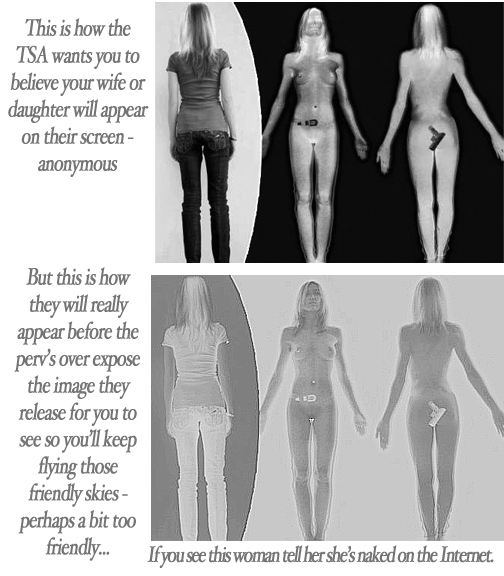
According to the TSA, the Whole Body Imagers do not reveal very much detail. The images are safe for Reader’s Digest and could even be posted in pre-schools. That is an exaggeration for even the downgraded images. That is an absurdity for the images that the Screener actually sees.
It is fascinating that these better images came out now. First the TSA had one of their security screening manuals leaked. Then they allowed the Nigerian crotch-bomber to fly – while it is true that the flight did not originate in the United States, the United States government received and approved the passenger list before the plane even took off. Then to respond the TSA harassed some bloggers and got caught. Then these more revealing images were released, including a video.
While Britain is undergoing a rather unfortunate bout of sex predator hysteria, causing parents to be considered suspects just for wanting to see their own kids in a school play, the hysteria there has had the beneficial side effect of having the government declare that the machines cannot be used on children. The TSA has admitted that minors are subject to full screening.
Finally, in spite of the many pronouncements about the medically safe millimeter wave technology being used, it appears that the TSA is also deploying unsafe X-Ray technology along side the millimeter wave technology, and that the person being screened is not likely to know which is being used. The only issues with millimeter wave technology are legal and constitutional. The only issues with X-Ray technology are legal, constitutional, and medical!
The TSA is being shown to the public for what it is, and it is ugly.
Friday, January 01, 2010
Social Creationism
A common accusation hurled at those who support a market without a central plan, is that of "Social Darwinism." The term is never explicitly defined in these particular cases, because a precise definition of the term renders it useless as any sort of attack against those who prefer markets that lack central plans.
But taking the critics of the free market at their words, hypothetically assuming there may be a basis to the epithet that is used in place of an argument, what exactly is the antithesis of Social Darwinism?
Since in the debates between science and religion the term "Darwinist" is used as an epithet against scientists by creationists, then would it not be proper to consider those who use the term "Social Darwinist" against free markets to be "Social Creationist"?
It may seem a silly line of reasoning, but consider the implications of "Social Creationism." It would imply that each person is born into a specific set social class and that the classes, like the species, are immutable. True, there may be "Micro Social Darwinism" where someone in the lower class can become a wealthier member of the lower class, and an aristocrat can fall upon hard times and become a less wealthy aristocrat, but no matter how wealthy a peasant is always a peasant and less of a person than the nobility. These roles are defined at the moment of creation and cannot be changed.
This fits very neatly with Marx' "class logic' where there was a 'proletarian logic' and a 'bourgeois logic'. One is a member of their class and it cannot be changed. In Marx' system, the different classes were inevitably at war and cannot be reconciled.
That is a point of view that also fits neatly with the pre-enlightenment mentality of nobility itself, that the peasants were beneath the nobility. Thus Aristocracy and Marxism are both Social Creationist philosophies.
It's an interesting mental exercise, and it would probably confound the person using "Social Darwinism" as an epithet if the rebuttal is to call the person a "Social Creationist."
But taking the critics of the free market at their words, hypothetically assuming there may be a basis to the epithet that is used in place of an argument, what exactly is the antithesis of Social Darwinism?
Since in the debates between science and religion the term "Darwinist" is used as an epithet against scientists by creationists, then would it not be proper to consider those who use the term "Social Darwinist" against free markets to be "Social Creationist"?
It may seem a silly line of reasoning, but consider the implications of "Social Creationism." It would imply that each person is born into a specific set social class and that the classes, like the species, are immutable. True, there may be "Micro Social Darwinism" where someone in the lower class can become a wealthier member of the lower class, and an aristocrat can fall upon hard times and become a less wealthy aristocrat, but no matter how wealthy a peasant is always a peasant and less of a person than the nobility. These roles are defined at the moment of creation and cannot be changed.
This fits very neatly with Marx' "class logic' where there was a 'proletarian logic' and a 'bourgeois logic'. One is a member of their class and it cannot be changed. In Marx' system, the different classes were inevitably at war and cannot be reconciled.
That is a point of view that also fits neatly with the pre-enlightenment mentality of nobility itself, that the peasants were beneath the nobility. Thus Aristocracy and Marxism are both Social Creationist philosophies.
It's an interesting mental exercise, and it would probably confound the person using "Social Darwinism" as an epithet if the rebuttal is to call the person a "Social Creationist."
Saturday, December 26, 2009
Obama is failing
Although Obama supporters continue to tell all doubters that it is far too early to judge whether Obama has been a successful president or not, and indicate that for the foreseeable future it will still be too early, there are indications that he has indeed become a failure in spite of all his good intentions.
There are two indicators that can be pointed at that show a weakening of support for Obama. The first is a Saturday Night Live skit featuring actors impersonating Barack Obama and Hu Jintao. This is the same show that did such a convincing impersonation of Sarah Palin that many Democrats actually think Palin said she could see Russia from her porch. The second is a week long series in Doonesbury in which Gary Trudeau, using the character Mark Slackmeyer as his mouth piece, has gone on a critical rampage against Obama's policy failings.
There are some groups that would never support Obama. Republicans never would for the same reason Republicans would never support any Democrat - they are in the hated other party. Crips hate Bloods and Bloods hate Crips. In spite of the insinuations, continued to the point of absurdity, that it is all about race, the simple truth is that Republicans won't support Obama because he's a Democrat.
Libertarians find that occasionally Obama appears that he might be willing to do things right, on very rare occasions, such as when he eventually got around to doing something about the war on drugs, but overall he is as much a disappointment as he was expected to be, that all the rhetoric about hope and change was to fool the gullible as most campaign promises are.
But those examples show voices that would normally be more supportive of Obama questioning their own president.
While the bailout has given the illusion of the recession being over, it is clear that the fundamental problems are not solved. The wars continue (as Obama promised) in spite of the hopes of his supporters that he would end them. Health care is in many ways a fiasco for the Democrats, as Obama campaigned on the public option and then stated he did not do so.
The year 2010 is going to be even worse economically than 2009. Will it still be too early to judge Obama?
There are two indicators that can be pointed at that show a weakening of support for Obama. The first is a Saturday Night Live skit featuring actors impersonating Barack Obama and Hu Jintao. This is the same show that did such a convincing impersonation of Sarah Palin that many Democrats actually think Palin said she could see Russia from her porch. The second is a week long series in Doonesbury in which Gary Trudeau, using the character Mark Slackmeyer as his mouth piece, has gone on a critical rampage against Obama's policy failings.
There are some groups that would never support Obama. Republicans never would for the same reason Republicans would never support any Democrat - they are in the hated other party. Crips hate Bloods and Bloods hate Crips. In spite of the insinuations, continued to the point of absurdity, that it is all about race, the simple truth is that Republicans won't support Obama because he's a Democrat.
Libertarians find that occasionally Obama appears that he might be willing to do things right, on very rare occasions, such as when he eventually got around to doing something about the war on drugs, but overall he is as much a disappointment as he was expected to be, that all the rhetoric about hope and change was to fool the gullible as most campaign promises are.
But those examples show voices that would normally be more supportive of Obama questioning their own president.
While the bailout has given the illusion of the recession being over, it is clear that the fundamental problems are not solved. The wars continue (as Obama promised) in spite of the hopes of his supporters that he would end them. Health care is in many ways a fiasco for the Democrats, as Obama campaigned on the public option and then stated he did not do so.
The year 2010 is going to be even worse economically than 2009. Will it still be too early to judge Obama?
Friday, December 18, 2009
No True Libertarian
"You say that your philosphy is strictly against any intervention in the economy. You say any intervention is a violation of your philosophy. Here is an intervention that I declare you like. If you disagree with me then you are engaging in the 'No True Scotsman' fallacy."
Everyone should be familiar with the "No True Scotsman" fallacy. It takes the form of someone denying that a potentially embarrassing member of a group is a member of a group at all. It is quite common in discussions of communism, where each and every despotic communist regime is said to be "not really communism." In rare occasions the defender of communist thought will try to label the system under discussion as capitalist because in the Soviet Union "there were a small number of rich people who owned and controlled everything and everyone else was poor."
"No True Scotsman" is useful for anyone who belongs to a group with active and vocal extremists committing acts that would embarrass the rest of the group. Communist regimes embarrass communists. The inquisition still embarrasses Christians.
But there is another fallacy, sort of a mirror image fallacy, that also comes into play. It is the "No True Libertarian" fallacy. It is not employed by members of the group under examination. It is employed by opponents of the group under examination. "You do not spit on the poor? You’re not a true libertarian." It gets its name because it was discovered in a debate in which someone who opposed libertarianism kept decrying his opponents of not being libertarian when they didn’t hold positions he said they should hold.
Various absurd positions that libertarians "should" take were brought up; embracing slavery, a willingness to turn family members into prostitutes, a desire to live in a world similar to "Mad Max" movies, etc. When people denied the extreme anti-libertarian positions, they were described as not real libertarians. And if libertarians point out that anti-libertarian positions are indeed not consistent with any form of libertarian thought, the anti-libertarians insist that means that libertarianism is nothing more than a pick and choose ideology.
So if a position that is inconsistent with libertarianism is said to be inconsistent with libertarianism, that means libertarianism is itself inconsistent?
According to all the attributes assigned to libertarians by those who oppose it, if one counts the number of libertarians who do not hold those ideas then there really are no true libertarians anywhere in the world.
Like last year, I urge people to give to the Salvation Army. As the economy worsens even more than last year, more people are in need of effective charity. I don't agree with them theologically, but I agree with the work they do. And since the FCC is asking us to reveal whether or not we receive any benefit from endorsements we make, it's none of their damn business.
Everyone should be familiar with the "No True Scotsman" fallacy. It takes the form of someone denying that a potentially embarrassing member of a group is a member of a group at all. It is quite common in discussions of communism, where each and every despotic communist regime is said to be "not really communism." In rare occasions the defender of communist thought will try to label the system under discussion as capitalist because in the Soviet Union "there were a small number of rich people who owned and controlled everything and everyone else was poor."
"No True Scotsman" is useful for anyone who belongs to a group with active and vocal extremists committing acts that would embarrass the rest of the group. Communist regimes embarrass communists. The inquisition still embarrasses Christians.
But there is another fallacy, sort of a mirror image fallacy, that also comes into play. It is the "No True Libertarian" fallacy. It is not employed by members of the group under examination. It is employed by opponents of the group under examination. "You do not spit on the poor? You’re not a true libertarian." It gets its name because it was discovered in a debate in which someone who opposed libertarianism kept decrying his opponents of not being libertarian when they didn’t hold positions he said they should hold.
Various absurd positions that libertarians "should" take were brought up; embracing slavery, a willingness to turn family members into prostitutes, a desire to live in a world similar to "Mad Max" movies, etc. When people denied the extreme anti-libertarian positions, they were described as not real libertarians. And if libertarians point out that anti-libertarian positions are indeed not consistent with any form of libertarian thought, the anti-libertarians insist that means that libertarianism is nothing more than a pick and choose ideology.
So if a position that is inconsistent with libertarianism is said to be inconsistent with libertarianism, that means libertarianism is itself inconsistent?
According to all the attributes assigned to libertarians by those who oppose it, if one counts the number of libertarians who do not hold those ideas then there really are no true libertarians anywhere in the world.
Like last year, I urge people to give to the Salvation Army. As the economy worsens even more than last year, more people are in need of effective charity. I don't agree with them theologically, but I agree with the work they do. And since the FCC is asking us to reveal whether or not we receive any benefit from endorsements we make, it's none of their damn business.
Sunday, December 13, 2009
What is a "good cop"?
There are no good police officers in the Portland Police Department of Portland, Oregon. Every single one of them is a "bad cop." Anyone who would pepper spray an eleven month old baby, or even do nothing when an eleven month old baby is pepper sprayed, is not only a bad cop but is no longer even remotely human.
Too many people have too relaxed a definition of "good cop". To them, a good cop is one who is not engaging in criminal activity. However, since a police officer's job is to apprehend those who are engaging in criminal activity, any officer who does not do that is by definition a bad cop. That includes failure to arrest fellow officers when fellow officers break the law.
There are no good cops in New York City Police Department. The officer who assaulted the critical mass cyclist was clearly a bad cop, but there were several other officers who stood around doing nothing when that happened. They did not arrest their fellow officer. Instead they initially corroborated his story, until a YouTube video gave lie to their version of events.
Given how increasingly criminal the police are acting, it is important to remember that just because a police officer does not personally break the law, it does not mean that officer is good. By failing to act they give consent to the actions of their fellow officers. For anyone short of an officer of the law, simply not breaking the law may be considered a valid definition, but police officers must be held to a higher standard due to the nature of their voluntarily chosen occupation.
There are no good cops in The Utah Highway Patrol. Instead they cleared the officer of all wrong-doing for using pain compliance and electroshock torture for someone who was not posing any sort of threat, but not giving abject obsequience to the officer either. If there was a single good cop in the whole organization, then Trooper Gardner would have been arrested for assault.
When the police start arresting the many bad apples within their own ranks, then it can be said there are good cops. Until that time their numbers are distressingly few.
Like last year, I urge people to give to the Salvation Army. As the economy worsens even more than last year, more people are in need of effective charity. I don't agree with them theologically, but I agree with the work they do. And since the FCC is asking us to reveal whether or not we receive any benefit from endorsements we make, it's none of their damn business.
Too many people have too relaxed a definition of "good cop". To them, a good cop is one who is not engaging in criminal activity. However, since a police officer's job is to apprehend those who are engaging in criminal activity, any officer who does not do that is by definition a bad cop. That includes failure to arrest fellow officers when fellow officers break the law.
There are no good cops in New York City Police Department. The officer who assaulted the critical mass cyclist was clearly a bad cop, but there were several other officers who stood around doing nothing when that happened. They did not arrest their fellow officer. Instead they initially corroborated his story, until a YouTube video gave lie to their version of events.
Given how increasingly criminal the police are acting, it is important to remember that just because a police officer does not personally break the law, it does not mean that officer is good. By failing to act they give consent to the actions of their fellow officers. For anyone short of an officer of the law, simply not breaking the law may be considered a valid definition, but police officers must be held to a higher standard due to the nature of their voluntarily chosen occupation.
There are no good cops in The Utah Highway Patrol. Instead they cleared the officer of all wrong-doing for using pain compliance and electroshock torture for someone who was not posing any sort of threat, but not giving abject obsequience to the officer either. If there was a single good cop in the whole organization, then Trooper Gardner would have been arrested for assault.
When the police start arresting the many bad apples within their own ranks, then it can be said there are good cops. Until that time their numbers are distressingly few.
Like last year, I urge people to give to the Salvation Army. As the economy worsens even more than last year, more people are in need of effective charity. I don't agree with them theologically, but I agree with the work they do. And since the FCC is asking us to reveal whether or not we receive any benefit from endorsements we make, it's none of their damn business.
Saturday, December 05, 2009
What is the free market?
"You believe the free market will take care of it."
Actually, no.
The person uttering that phrase is making an unwarranted assumption, that the free market is a centrally planned economic system just like all the others. The difference being that the person is implying that the free market is an independent self-aware quasi-omnipotent entity that does the central planning.
What "the free market" actually is, is the lack of any central planning. That's all it is. It is not an alternate method of organizing the economy. It is not replacing a physical central planner with an intangible central planner. It is simply the lack of a method of organizing the economy, the lack of a central planner. It is the millions of individuals engaging in billions of interactions and making trillions of decisions, all without being told what to do by some third party.
Given what the free market actually is, when someone is accused of trusting the free market, what that person is actually trusting is each individual to make his own decisions. Someone who "trusts the free market" trusts the people to act on their own behalf in their own best interest within the confines of their own knowledge.
The only people not trusted by someone who trusts "the free market" are those that say "I am equipped to make decisions for you." That person is a central planner, and the free market is only the lack of a central plan. Many people like that are unable to comprehend the absense of any central plan, which is why they must identify some kind of planner, somehow, in the free market, even if they have to make it up.
Like last year, I urge people to give to the Salvation Army. As the economy worsens even more than last year, more people are in need of effective charity. I don't agree with them theologically, but I agree with the work they do. And since the FCC is asking us to reveal whether or not we receive any benefit from endorsements we make, it's none of their damn business.
Actually, no.
The person uttering that phrase is making an unwarranted assumption, that the free market is a centrally planned economic system just like all the others. The difference being that the person is implying that the free market is an independent self-aware quasi-omnipotent entity that does the central planning.
What "the free market" actually is, is the lack of any central planning. That's all it is. It is not an alternate method of organizing the economy. It is not replacing a physical central planner with an intangible central planner. It is simply the lack of a method of organizing the economy, the lack of a central planner. It is the millions of individuals engaging in billions of interactions and making trillions of decisions, all without being told what to do by some third party.
Given what the free market actually is, when someone is accused of trusting the free market, what that person is actually trusting is each individual to make his own decisions. Someone who "trusts the free market" trusts the people to act on their own behalf in their own best interest within the confines of their own knowledge.
The only people not trusted by someone who trusts "the free market" are those that say "I am equipped to make decisions for you." That person is a central planner, and the free market is only the lack of a central plan. Many people like that are unable to comprehend the absense of any central plan, which is why they must identify some kind of planner, somehow, in the free market, even if they have to make it up.
Like last year, I urge people to give to the Salvation Army. As the economy worsens even more than last year, more people are in need of effective charity. I don't agree with them theologically, but I agree with the work they do. And since the FCC is asking us to reveal whether or not we receive any benefit from endorsements we make, it's none of their damn business.
Sunday, November 29, 2009
Lack Friday
It is time for the Keynesian economists to predict disaster in spite of their pronouncements that the economy was finally recovering. They announced a fragile recovery and a jobless recovery. Then "Black Friday" failed to occur. The single biggest shopping day of the year happened without the massive crowds normally associated with that day.
Retailers were reporting that conditions were basically the same as any normal business day, and that by early evening the stores were fairly deserted. Although there were shoppers seeking good deals on high end items, it appeared that they were shopping for replacements for worn appliances, and not purchasing items like plasma televisions and other luxury consumer goods.
As is preached by Austrian economists, people are saving their money because they are in a recession. Many businesses look forward to "Black Friday" and the rest of the holiday season, as Christmas shopping helps sustain the businesses through the rest of the year. If the 2009 Christmas season fails to provide the profits usually associated with Christmas shopping many of the businesses that depend on it may not make it through the rest of the year.
The Keynesian solution is more stimulus. The message among those in political circles will be that people aren't spending enough.
People are saving money because it is the sensible thing to do, especially in economic hard time. The official unemployment rate is around 10%, the unofficial (and more accurate) rate is aroudn 20%, and the rate among 18 - 30 year olds is 50%. The money isn't there to be spent. Going further into debt is the very last thing peole need to do right now, even if the banks were lending.
If "Black Friday" i an indication of things to come, the situation is more accurately described as "Lack Friday". First the stores will lack customers, and then thanks to government efforts to remedy the situation the people will lack money and freedom.
Retailers were reporting that conditions were basically the same as any normal business day, and that by early evening the stores were fairly deserted. Although there were shoppers seeking good deals on high end items, it appeared that they were shopping for replacements for worn appliances, and not purchasing items like plasma televisions and other luxury consumer goods.
As is preached by Austrian economists, people are saving their money because they are in a recession. Many businesses look forward to "Black Friday" and the rest of the holiday season, as Christmas shopping helps sustain the businesses through the rest of the year. If the 2009 Christmas season fails to provide the profits usually associated with Christmas shopping many of the businesses that depend on it may not make it through the rest of the year.
The Keynesian solution is more stimulus. The message among those in political circles will be that people aren't spending enough.
People are saving money because it is the sensible thing to do, especially in economic hard time. The official unemployment rate is around 10%, the unofficial (and more accurate) rate is aroudn 20%, and the rate among 18 - 30 year olds is 50%. The money isn't there to be spent. Going further into debt is the very last thing peole need to do right now, even if the banks were lending.
If "Black Friday" i an indication of things to come, the situation is more accurately described as "Lack Friday". First the stores will lack customers, and then thanks to government efforts to remedy the situation the people will lack money and freedom.
Sunday, November 22, 2009
Economics for Scientists
The relationship between the social sciences and the natural sciences has always been a little strained, with social sciences constantly seeking the approval of the natural sciences. The social sciences cannot use the same methodology as the natural sciences, which causes too many natural scientists to look on the social sciences as having little to value.
That is not to say that all social sciences suffer from this problem. The sciences of anthropology and archaeology are quite well accepted, and psychology mostly so, but too far beyond that and the value, as seen by a natural scientist, diminishes rapidly.
Some of the fault for this does lie in the social sciences themselves. If one is to study psychology, the basic courses are more of a history of psychology, where each theory is studied, and then the refutation by the competing school is offered. An equivalent in the natural sciences would be for a physicist to have to study phlogiston and for a biologist to have to study the four humours. They are valuable in a history of science class, but have no actual value to someone seeking to learn science now.
Some in the social sciences feel the problem is that the issues studied aren't expressed mathematically. This is the solution adopted by Keynesians, and since that ideology is currently dominant other economists who wish official approval adopt the practice of trying to express everything in number. This includes some factors that cannot accurately be measured, such as "consumer confidence" or "satisfaction."
There is an aspect to Keynesian economics that would appeal to engineers, in that the Keynesian economic model present society as a machine, and if a certain input is inserted at one end a certain end result comes out of the other. But that alone doesn’t make Keynesian economics scientific.
The underlying basis of science is "does it work." That may sound like a strange stipulation to a person who read "Pragmatic Politics" but unlike the pseudo-pragmatists, when a scientist says "does it work" the scientist is operating from a specific premise. "Pragmatic Politics" also argued that any time someone asks that question they person asking it is acting from a particular premise of what goal the person asking it is trying to achieve. In the case of the scientist, the goal is a theory that accurately describes the real world and can be used to make accurate predictions.
It is said that when Einstein had finished developing his theories, he was quite distressed that as a consequence of his formulas black holes were predicted. He checked his work many times, but eventually came to the conclusion that the data said what the data said. As much as he personally disliked the idea of black holes, the theory was meant to reflect the world and he had to accept it as it was. Later on corroborating evidence was found that showed the mathematics were correct.
That is what made his theories scientific. They were designed to reflect the world, not the way he wished the world to be. They made predictions that could be tested. And unlike the theories that were replaced by Einstein’s theories, the tests showed that the theories accurately modeled the world.
All the currently competing schools of economics make predictions. Keynesian economics predicts that manipulation of aggregate demand can lead to a prosperous economy. Monetarist economics predicts that manipulation of the money supply can lead to a prosperous economy. And both of those have been discredited by events. If a theory is supposed to model the real world, then neither Keynesianism nor Monetarism are theories.
Once a theory has been discredited by the data, continuing to hold to that theory is no longer scientific but an act of faith.
Austrian economics, however, has been validated by events. Although it lacks the mathematics that many consider to be necessary for a scientific theory, an honest analysis shows that the predictions have been accurate. Since it is not the mathematics but the predictive power of a theory that makes it scientific, that means that Austrian economics is indeed a scientific theory of economics.
Although there are those scientists who might initially find it unappealing, if they emulate Einstein they will reluctantly embrace it because of its verified predictive power in spite of whatever political ideology they hold.
That is not to say that all social sciences suffer from this problem. The sciences of anthropology and archaeology are quite well accepted, and psychology mostly so, but too far beyond that and the value, as seen by a natural scientist, diminishes rapidly.
Some of the fault for this does lie in the social sciences themselves. If one is to study psychology, the basic courses are more of a history of psychology, where each theory is studied, and then the refutation by the competing school is offered. An equivalent in the natural sciences would be for a physicist to have to study phlogiston and for a biologist to have to study the four humours. They are valuable in a history of science class, but have no actual value to someone seeking to learn science now.
Some in the social sciences feel the problem is that the issues studied aren't expressed mathematically. This is the solution adopted by Keynesians, and since that ideology is currently dominant other economists who wish official approval adopt the practice of trying to express everything in number. This includes some factors that cannot accurately be measured, such as "consumer confidence" or "satisfaction."
There is an aspect to Keynesian economics that would appeal to engineers, in that the Keynesian economic model present society as a machine, and if a certain input is inserted at one end a certain end result comes out of the other. But that alone doesn’t make Keynesian economics scientific.
The underlying basis of science is "does it work." That may sound like a strange stipulation to a person who read "Pragmatic Politics" but unlike the pseudo-pragmatists, when a scientist says "does it work" the scientist is operating from a specific premise. "Pragmatic Politics" also argued that any time someone asks that question they person asking it is acting from a particular premise of what goal the person asking it is trying to achieve. In the case of the scientist, the goal is a theory that accurately describes the real world and can be used to make accurate predictions.
It is said that when Einstein had finished developing his theories, he was quite distressed that as a consequence of his formulas black holes were predicted. He checked his work many times, but eventually came to the conclusion that the data said what the data said. As much as he personally disliked the idea of black holes, the theory was meant to reflect the world and he had to accept it as it was. Later on corroborating evidence was found that showed the mathematics were correct.
That is what made his theories scientific. They were designed to reflect the world, not the way he wished the world to be. They made predictions that could be tested. And unlike the theories that were replaced by Einstein’s theories, the tests showed that the theories accurately modeled the world.
All the currently competing schools of economics make predictions. Keynesian economics predicts that manipulation of aggregate demand can lead to a prosperous economy. Monetarist economics predicts that manipulation of the money supply can lead to a prosperous economy. And both of those have been discredited by events. If a theory is supposed to model the real world, then neither Keynesianism nor Monetarism are theories.
Once a theory has been discredited by the data, continuing to hold to that theory is no longer scientific but an act of faith.
Austrian economics, however, has been validated by events. Although it lacks the mathematics that many consider to be necessary for a scientific theory, an honest analysis shows that the predictions have been accurate. Since it is not the mathematics but the predictive power of a theory that makes it scientific, that means that Austrian economics is indeed a scientific theory of economics.
Although there are those scientists who might initially find it unappealing, if they emulate Einstein they will reluctantly embrace it because of its verified predictive power in spite of whatever political ideology they hold.
Saturday, November 14, 2009
One Healthcare Reform
Proponents of the current healthcare reform proposal in congress like to accuse critics of not offering any alternatives, of only opposing without offering anything. While that accusation is completely not true, it serve proponents of the fascist system well as a big lie, just as calling it socialist instead of fascist serves as another convenient lie.
Rather than dissect any particular part of the fascist bill, a refutation of the false charge that critics offer nothing is also useful. The reason the proponents say that critics offer nothing is because only big government solutions are allowed to be considered. Anything else is not a "constructive proposal" and thus they can get away with that big lie.
In spite of the psychological block against small government proposals being considered, it is always useful to suggest as many small government solutions as possible. That way the next time someone says that critics of fascist health care never offer solutions the critics can respond with "look at all the solutions I've offered that you refuse to consider."
Given the large number of problems, any single solution fails to address the full problem and appears short sighted. But one aspect is all that can be addressed at once.
One of the problems with the current system is that the patient is not the customer. When a doctor treats a patient, the patient isn't the customer. The insurance pays for the visit, and so the insurance is the customer. And who is the insurance company's customer? Since most people get their insurance through their employer, the employer is the customer and not the employee. It is true that sufficient employee complaints can cause an employer to switch companies, but the customer of the insurance company is the employer.
For a truly responsive insurance company, the patient needs to be the customer of the insurance company. For truly responsive health care, the patient needs to be the customer of the doctor. The only remaining question of this particular solution is how to make it possible. As proponents of fascist health care are quick to point out, the average person cannot afford a catastrophic illness.
The first part of the solution is to transfer the tax incentive for the purchase of health insurance from the employer to the employee. That way, unlike the Obama plan, people have a positive encouragement to purchase insurance instead of a punishment for failure to purchase insurance. Persuasion always being preferable to force, encouraging people to purchase insurance instead of punishing them for failure to purchase insurance is a better solution.
To make insurance affordable enough for a person to purchase it, the price needs to be brought down. That can be done through coercion or through encouragement. To do it through encouragement the best way to do it is through removing the rules that prohibit insurance companies from competing across state lines. Putting individual insurance policies in the hand of the customers while simultaneously increasing the number of companies and policies available, while giving people a tax break for purchasing insurance, will drive down the cost to the point where most people can afford it.
Another way to make insurance affordable is to remember that insurance is supposed to be for the unusual event. The way health insurance currently operates is absurd - it is comparable to using automobile insurance to pay for basic tune-ups, or even to pay for putting gas in the car.
Analyzing a standard insurance statement or doctor's visit statement, one finds that in general a large portion of a standard bill is an insurance negotiated adjustment. Another large portion is the patient co-pay. The smallest part is the payment the insurance company makes to the doctor. Ask most doctors what their cash price is and it turns out it is actually lower than the stated price for a visit.
People need to pay directly for office visits, and a good way to do that is through tax deductible healthcare savings accounts. But not the HSAs currently in use, that have an end of year use-or-lose for the funds. What is needed is a roll-over HSA, that allows people to put in more funds than needed while healthy so that the funds will be there many years later when people need more healthcare funds. This is similar to using a retirement savings account. In order to encourage use of a roll-over HSA account funds put into it should be tax free, just as in the current annual HSA.
That will give our current healthcare system another thirty years of operation before it gets as bad as it currently is.
Rather than dissect any particular part of the fascist bill, a refutation of the false charge that critics offer nothing is also useful. The reason the proponents say that critics offer nothing is because only big government solutions are allowed to be considered. Anything else is not a "constructive proposal" and thus they can get away with that big lie.
In spite of the psychological block against small government proposals being considered, it is always useful to suggest as many small government solutions as possible. That way the next time someone says that critics of fascist health care never offer solutions the critics can respond with "look at all the solutions I've offered that you refuse to consider."
Given the large number of problems, any single solution fails to address the full problem and appears short sighted. But one aspect is all that can be addressed at once.
One of the problems with the current system is that the patient is not the customer. When a doctor treats a patient, the patient isn't the customer. The insurance pays for the visit, and so the insurance is the customer. And who is the insurance company's customer? Since most people get their insurance through their employer, the employer is the customer and not the employee. It is true that sufficient employee complaints can cause an employer to switch companies, but the customer of the insurance company is the employer.
For a truly responsive insurance company, the patient needs to be the customer of the insurance company. For truly responsive health care, the patient needs to be the customer of the doctor. The only remaining question of this particular solution is how to make it possible. As proponents of fascist health care are quick to point out, the average person cannot afford a catastrophic illness.
The first part of the solution is to transfer the tax incentive for the purchase of health insurance from the employer to the employee. That way, unlike the Obama plan, people have a positive encouragement to purchase insurance instead of a punishment for failure to purchase insurance. Persuasion always being preferable to force, encouraging people to purchase insurance instead of punishing them for failure to purchase insurance is a better solution.
To make insurance affordable enough for a person to purchase it, the price needs to be brought down. That can be done through coercion or through encouragement. To do it through encouragement the best way to do it is through removing the rules that prohibit insurance companies from competing across state lines. Putting individual insurance policies in the hand of the customers while simultaneously increasing the number of companies and policies available, while giving people a tax break for purchasing insurance, will drive down the cost to the point where most people can afford it.
Another way to make insurance affordable is to remember that insurance is supposed to be for the unusual event. The way health insurance currently operates is absurd - it is comparable to using automobile insurance to pay for basic tune-ups, or even to pay for putting gas in the car.
Analyzing a standard insurance statement or doctor's visit statement, one finds that in general a large portion of a standard bill is an insurance negotiated adjustment. Another large portion is the patient co-pay. The smallest part is the payment the insurance company makes to the doctor. Ask most doctors what their cash price is and it turns out it is actually lower than the stated price for a visit.
People need to pay directly for office visits, and a good way to do that is through tax deductible healthcare savings accounts. But not the HSAs currently in use, that have an end of year use-or-lose for the funds. What is needed is a roll-over HSA, that allows people to put in more funds than needed while healthy so that the funds will be there many years later when people need more healthcare funds. This is similar to using a retirement savings account. In order to encourage use of a roll-over HSA account funds put into it should be tax free, just as in the current annual HSA.
That will give our current healthcare system another thirty years of operation before it gets as bad as it currently is.
Saturday, November 07, 2009
The empire cripples itself
Recently there was a story in the Army Times about how youths in the United States are generally unfit for military service. Too many potential recruits are either insufficiently educated, physically unfit, or have criminal records.
It is quite interesting because these youths are the products of government run taxpayer funded schools. Theoretically the government would want a population that is fit enough for military service, and as such would ensure the government run schools would provide a population that is smart enough, fit enough, and motivated enough to serve in the military.
This is one of the fundamental flaws of empire. On the one hand empire needs a population that is fit, intelligent, and motivated, so that these people can serve in ways necessary to administer the empire over other people. On the other hand, due to the repressive nature of empires back home, the empire needs a population that is under-informed, docile, and apathetic. It is very difficult to achieve both of those goals at the same time.
It is true that there is a way out of the dilemma, and that is to have a very militaristic educational system that emphasizes obedience above all else while educating in the basics of reading, writing, and arithmetic. But that is not what happened in the United States. With the emphasis being on not educating the public, the result is a public that is functionally illiterate. Michael Jackson’s funeral has more public interest than Ron Paul’s Audit the Fed bill.
It’s clear that the emphasis isn’t on education, even though nobody in the education system (other than John Taylor Gatto) will ever admit to such. It is clear because you hear complaints about “teaching to the test” and complaints about people entering the work force unqualified. Many college have a basic skills department to remedy the lack in even reading and arithmetic among entering students. If there really was a desire among the leadership in this country to produce an educated public, it could be accomplished, so therefore one must logically conclude that desire is not there.
Small wonder that among those who do seek employ in the government, too many of them are more than willing to abuse their position instead of think about the responsibilities of their position. More and more it is becoming apparent that while prosecutors have the necessary specialized knowledge of law to perform their job they have no knowledge about the philosophy of the laws they enforce and never stop to consider the ethics of their actions. More and more it is becoming apparent that too many police are no longer different from the criminals they are supposed to stop and are instead merely criminals with official permission to act. Just as the education system fails to provide soldiers, it fails to provide police.
Among the fields that require extensive thought, many of the engineering and medical students in this country are students who grew up in foreign countries and are now studying in the United States. Engineers and doctors study the humanities, but very few in politics have studied even the rudiments of science.
An empire will fail either because the public will not tolerate the domestic abuses needed to maintain an empire abroad, or because the public is too apathetic or unfit to maintain the empire abroad. It is clear which of these two paths has been chosen by the United States government.
It is quite interesting because these youths are the products of government run taxpayer funded schools. Theoretically the government would want a population that is fit enough for military service, and as such would ensure the government run schools would provide a population that is smart enough, fit enough, and motivated enough to serve in the military.
This is one of the fundamental flaws of empire. On the one hand empire needs a population that is fit, intelligent, and motivated, so that these people can serve in ways necessary to administer the empire over other people. On the other hand, due to the repressive nature of empires back home, the empire needs a population that is under-informed, docile, and apathetic. It is very difficult to achieve both of those goals at the same time.
It is true that there is a way out of the dilemma, and that is to have a very militaristic educational system that emphasizes obedience above all else while educating in the basics of reading, writing, and arithmetic. But that is not what happened in the United States. With the emphasis being on not educating the public, the result is a public that is functionally illiterate. Michael Jackson’s funeral has more public interest than Ron Paul’s Audit the Fed bill.
It’s clear that the emphasis isn’t on education, even though nobody in the education system (other than John Taylor Gatto) will ever admit to such. It is clear because you hear complaints about “teaching to the test” and complaints about people entering the work force unqualified. Many college have a basic skills department to remedy the lack in even reading and arithmetic among entering students. If there really was a desire among the leadership in this country to produce an educated public, it could be accomplished, so therefore one must logically conclude that desire is not there.
Small wonder that among those who do seek employ in the government, too many of them are more than willing to abuse their position instead of think about the responsibilities of their position. More and more it is becoming apparent that while prosecutors have the necessary specialized knowledge of law to perform their job they have no knowledge about the philosophy of the laws they enforce and never stop to consider the ethics of their actions. More and more it is becoming apparent that too many police are no longer different from the criminals they are supposed to stop and are instead merely criminals with official permission to act. Just as the education system fails to provide soldiers, it fails to provide police.
Among the fields that require extensive thought, many of the engineering and medical students in this country are students who grew up in foreign countries and are now studying in the United States. Engineers and doctors study the humanities, but very few in politics have studied even the rudiments of science.
An empire will fail either because the public will not tolerate the domestic abuses needed to maintain an empire abroad, or because the public is too apathetic or unfit to maintain the empire abroad. It is clear which of these two paths has been chosen by the United States government.
Saturday, October 31, 2009
Bush the Socialist, Obama the Fascist
Sometime in the early 1980s the colors used to represent the two primary political parties swapped. For many years the Republicans were represented by the color Blue and the Democrats were represented by the color Red. In a way that made sense, as the Republicans were portrayed as the Blue Bloods, the "aristocracy", while the Democrats were portrayed as the ones soft on Communism.
For reasons unknown the parties switched colors, to the point where few remember that they had the other colors as recently as 1980. Now saying a state is a "Red State" is a way to indicate that it is strongly Republican or conservative.
But events since the year 2000 would lead one to conclude that perhaps the switch in colors is accurate to some extent. Bush is clearly more socialist than Obama, and Obama is clearly more fascist than Bush. It should be noted at this point that there are many purists who insist that "Socialism" can only and ever refer to ownership of the means of production, and that wealth redistribution through other means - such as welfare - doesn't count as socialism. For the sake of argument, wealth redistribution will be referred to as "welfare socialism", and from this point on any reference to "socialism" will actually refer to "welfare socialism."
More than once during the Bush presidency efforts were made to avoid economic problems through bailouts. The interesting point is that more than once Bush had checks made out directly to the people. They were not large checks, about $300 per person, but he ordered them issued directly from the treasury to the public. Keynesian advisors warned against this on the grounds that the money might be wasted on foolish expenditures such as paying off credit cards or paying other bills. That did not deter Bush in his effort to strengthen the ailing economy through efforts aimed at the common man.
While both Bush and Obama gave money directly to failing banks, Obama has only given money to the failing banks and automobile companies. A common Republican quip has been "Where's my bailout?" to show that Obama is only giving money to the wealthiest of the public, not to the common person.
On healthcare the same pattern holds. Bush authorized the largest expansion of Medicare ever, with Perscription Drug Coverage for Seniors. Obama appears ready to jettison the "public option" in favor of mandating that everyone purchase health insurance.
Little wonder there is such discontent between the base and the party leadership in the Republican Party today, that a third party candidate may win the 23rd Congressional District in New York. Likewise the anti-war movement has little to be happy about with Obama, and Fascists are well known for their militancy.
For reasons unknown the parties switched colors, to the point where few remember that they had the other colors as recently as 1980. Now saying a state is a "Red State" is a way to indicate that it is strongly Republican or conservative.
But events since the year 2000 would lead one to conclude that perhaps the switch in colors is accurate to some extent. Bush is clearly more socialist than Obama, and Obama is clearly more fascist than Bush. It should be noted at this point that there are many purists who insist that "Socialism" can only and ever refer to ownership of the means of production, and that wealth redistribution through other means - such as welfare - doesn't count as socialism. For the sake of argument, wealth redistribution will be referred to as "welfare socialism", and from this point on any reference to "socialism" will actually refer to "welfare socialism."
More than once during the Bush presidency efforts were made to avoid economic problems through bailouts. The interesting point is that more than once Bush had checks made out directly to the people. They were not large checks, about $300 per person, but he ordered them issued directly from the treasury to the public. Keynesian advisors warned against this on the grounds that the money might be wasted on foolish expenditures such as paying off credit cards or paying other bills. That did not deter Bush in his effort to strengthen the ailing economy through efforts aimed at the common man.
While both Bush and Obama gave money directly to failing banks, Obama has only given money to the failing banks and automobile companies. A common Republican quip has been "Where's my bailout?" to show that Obama is only giving money to the wealthiest of the public, not to the common person.
On healthcare the same pattern holds. Bush authorized the largest expansion of Medicare ever, with Perscription Drug Coverage for Seniors. Obama appears ready to jettison the "public option" in favor of mandating that everyone purchase health insurance.
Little wonder there is such discontent between the base and the party leadership in the Republican Party today, that a third party candidate may win the 23rd Congressional District in New York. Likewise the anti-war movement has little to be happy about with Obama, and Fascists are well known for their militancy.
Saturday, October 24, 2009
What can I do?
It is a common question that haunts anyone who wants to increase liberty. When looking at all the ways government is advancing and liberty is diminishing, it is tempting to give in to despair. It is true that there is little that one person can do. Any large scale changes will involve large group efforts, true. So should a person give up and wait for said group efforts?
No, there is no reason to give in to despair. There is no reason to give up. There is still something that can be done. One can be prepared to ride the depression out and come out and prepare to come out on the other side.
The first thing to do is make sure that one is not fooled by the official propaganda. Anyone who has an evidence based view of economics knows that the current depression has utterly disproven Keynesian and Monetarist economics and vindicated Austrian economics. In spite of that, government economists and major media economists continue with the party line about government managed economies.
Keeping the facts in mind reveals that this is the worst time to sell gold for cash and to get further into debt. In spite of pronouncements that the depression is over, it is clear that the money pumped into the economy has done nothing more than re-inflated a few bubbles and paid off the major bankers. Using the knowledge gained by Austrian Economics, it is much easier to avoid the remaining bubbles.
Individually, the only thing a person can do is ensure his own house is in order. That's why many people advise starting a farm and other common sense measures.
Given how the police have gotten more dangerous, the best plan is not to confront them but to stay out of their sight as much as possible. Any talking back, even if in the right, is considered "contempt of cop" and results in an arrest for "disorderly conduct". A lucky person won't be tasered during the arrest for the crime of saying "what am I being arrested for?"
Of course, be armed, be ready to defend yourself. Be as prepared as possible for the various emergencies that may come up if the predictions of Austrian Economists continue to come to pass as they have done to this point. The only way to act to advance liberty is if the activist is able to act in the first place.
No, there is no reason to give in to despair. There is no reason to give up. There is still something that can be done. One can be prepared to ride the depression out and come out and prepare to come out on the other side.
The first thing to do is make sure that one is not fooled by the official propaganda. Anyone who has an evidence based view of economics knows that the current depression has utterly disproven Keynesian and Monetarist economics and vindicated Austrian economics. In spite of that, government economists and major media economists continue with the party line about government managed economies.
Keeping the facts in mind reveals that this is the worst time to sell gold for cash and to get further into debt. In spite of pronouncements that the depression is over, it is clear that the money pumped into the economy has done nothing more than re-inflated a few bubbles and paid off the major bankers. Using the knowledge gained by Austrian Economics, it is much easier to avoid the remaining bubbles.
Individually, the only thing a person can do is ensure his own house is in order. That's why many people advise starting a farm and other common sense measures.
Given how the police have gotten more dangerous, the best plan is not to confront them but to stay out of their sight as much as possible. Any talking back, even if in the right, is considered "contempt of cop" and results in an arrest for "disorderly conduct". A lucky person won't be tasered during the arrest for the crime of saying "what am I being arrested for?"
Of course, be armed, be ready to defend yourself. Be as prepared as possible for the various emergencies that may come up if the predictions of Austrian Economists continue to come to pass as they have done to this point. The only way to act to advance liberty is if the activist is able to act in the first place.
Saturday, October 17, 2009
The Is / Ought Fallacy
"Without Taxes, how will we pay for roads and schools and medical care?"
It is a common enough question whenever someone objects, not just to all taxes as is proper to do, not just to the current level which is excessive to all minarchists and many other thinking people, but even to proposed increases in taxes which will be used to fund new programs.
At first glance it appears to be an application of the Statist Fallacy, there is also another fallacy at play here, the Is / Ought fallacy. It is a Statist Fallacy because the assumption is that if the government doesn't provide these services than nobody will, and that by opposing the government being the provider of these services one also opposes the services being provided at all.
But it is also an is / ought fallacy. The speaker is assuming that the way things are, that the government provides these services, is the way things ought to be, and by expressing the point in that particular way the speaker is hoping to lay a verbal trap for any opponent of expanded government. One can either deny that taxes should pay for those and because of the statist fallacy agree that those should not exist, or one can agree that those services are valuable and because of the is / ought fallacy agree that the government should fund them.
A good answer is "since currently those are paid for by taxes, we currently need taxes to pay for those" and then immediately accuse the speaker of engaging in the is / ought fallacy. The inclusion of the word "currently", twice in one answer, allows the libertarian in the argument to sidestep the trap of either embracing the statist fallacy or the is / ought fallacy, and it becomes very difficult for even a determined statist to pull a quote out of context. Leaving out either instance of that word eases decontextualization and the ability to try to argue that the libertarian is actually agreeing on some level with the statist.
"Since currently those are paid for by taxes, we currently need taxes to pay for those. What a fine example of the is / ought fallacy, where since that is the way it is therefore that is the way it ought to be. Why ought it be that way? Is there no other way to fund those besides taxes?"
It is a common enough question whenever someone objects, not just to all taxes as is proper to do, not just to the current level which is excessive to all minarchists and many other thinking people, but even to proposed increases in taxes which will be used to fund new programs.
At first glance it appears to be an application of the Statist Fallacy, there is also another fallacy at play here, the Is / Ought fallacy. It is a Statist Fallacy because the assumption is that if the government doesn't provide these services than nobody will, and that by opposing the government being the provider of these services one also opposes the services being provided at all.
But it is also an is / ought fallacy. The speaker is assuming that the way things are, that the government provides these services, is the way things ought to be, and by expressing the point in that particular way the speaker is hoping to lay a verbal trap for any opponent of expanded government. One can either deny that taxes should pay for those and because of the statist fallacy agree that those should not exist, or one can agree that those services are valuable and because of the is / ought fallacy agree that the government should fund them.
A good answer is "since currently those are paid for by taxes, we currently need taxes to pay for those" and then immediately accuse the speaker of engaging in the is / ought fallacy. The inclusion of the word "currently", twice in one answer, allows the libertarian in the argument to sidestep the trap of either embracing the statist fallacy or the is / ought fallacy, and it becomes very difficult for even a determined statist to pull a quote out of context. Leaving out either instance of that word eases decontextualization and the ability to try to argue that the libertarian is actually agreeing on some level with the statist.
"Since currently those are paid for by taxes, we currently need taxes to pay for those. What a fine example of the is / ought fallacy, where since that is the way it is therefore that is the way it ought to be. Why ought it be that way? Is there no other way to fund those besides taxes?"
Friday, October 09, 2009
Traffic Lights
There is an anti-libertarian argument that, no matter how often refuted, comes up often and proceeds along these lines: Some order is necessary, such as traffic lights and speed limits. Libertarians would want to do away with traffic lights and speed limits because the government put them in place, even thought the government did so to keep us from killing each other while driving. You need some order to function as a society.
There are many errors contained in that one argument.
First of all, it is not the position of any consistent libertarian that the government should not be able to set rules for traffic on any government road. It’s simply a matter of application of property rights. A libertarian could easily defend traffic regulation by saying “whereas the government is the owner of the roads, the government has the authority to set the terms for the use of the roads.” A much more consistent libertarian argument would simply include one more word and say “whereas unfortunately the government is the owner of the roads, the government has the authority to set the terms for the use of the roads.” This argument is valid even for those who do not recognize the legitimacy of government ownership of anything because de facto the government owns them whether the legitimacy of the ownership is recognized or not.
But that does not address the deeper misunderstanding. Libertarianism is not, and never has been, against order. Libertarianism is merely opposed to externally imposed order, order brought to society at the point of a gun. Libertarians have long endorsed spontaneous order, the order that can be found inside chaotic systems such as the free market. The accusation of objection to order at all is a red herring, designed to throw people off of finding out what it is that libertarians are really objecting to.
Libertarians do not object to voluntary cooperation. In fact, for the free market (advocated by all libertarians) to function voluntary cooperation is a necessity. Buyer and seller are cooperating voluntarily, from the level of the smallest hot-dog vendor on the sidewalk and his customer to the largest corporation.
The market isn’t the only way libertarians see spontaneous order. Every day people get married and start families. While some marriages are planned, how many of them are centrally planned? The whole of society is one giant exercise in spontaneous organization.
It is only when that organization is imposed by force, externally, do libertarians object. And usually the imposition is from government. It can be from criminal organizations, but more often than not criminal organizations are pale imitations of the government.
Accusing libertarians of being anti-organization because libertarians are opposed to externally imposed organization, imposed at the point of a gun, also overlooks that the amount of chaos commonly associated with anarchy can only be created by government. As Doug Newman said, “When you let people do whatever they want, you get Woodstock; when you let governments do whatever they want, you get Auschwitz.” In the United States instead of Auschwitz so far all we’ve gotten is the anarchy (caused by government) of the reaction to hurricane Katrina.
There are many errors contained in that one argument.
First of all, it is not the position of any consistent libertarian that the government should not be able to set rules for traffic on any government road. It’s simply a matter of application of property rights. A libertarian could easily defend traffic regulation by saying “whereas the government is the owner of the roads, the government has the authority to set the terms for the use of the roads.” A much more consistent libertarian argument would simply include one more word and say “whereas unfortunately the government is the owner of the roads, the government has the authority to set the terms for the use of the roads.” This argument is valid even for those who do not recognize the legitimacy of government ownership of anything because de facto the government owns them whether the legitimacy of the ownership is recognized or not.
But that does not address the deeper misunderstanding. Libertarianism is not, and never has been, against order. Libertarianism is merely opposed to externally imposed order, order brought to society at the point of a gun. Libertarians have long endorsed spontaneous order, the order that can be found inside chaotic systems such as the free market. The accusation of objection to order at all is a red herring, designed to throw people off of finding out what it is that libertarians are really objecting to.
Libertarians do not object to voluntary cooperation. In fact, for the free market (advocated by all libertarians) to function voluntary cooperation is a necessity. Buyer and seller are cooperating voluntarily, from the level of the smallest hot-dog vendor on the sidewalk and his customer to the largest corporation.
The market isn’t the only way libertarians see spontaneous order. Every day people get married and start families. While some marriages are planned, how many of them are centrally planned? The whole of society is one giant exercise in spontaneous organization.
It is only when that organization is imposed by force, externally, do libertarians object. And usually the imposition is from government. It can be from criminal organizations, but more often than not criminal organizations are pale imitations of the government.
Accusing libertarians of being anti-organization because libertarians are opposed to externally imposed organization, imposed at the point of a gun, also overlooks that the amount of chaos commonly associated with anarchy can only be created by government. As Doug Newman said, “When you let people do whatever they want, you get Woodstock; when you let governments do whatever they want, you get Auschwitz.” In the United States instead of Auschwitz so far all we’ve gotten is the anarchy (caused by government) of the reaction to hurricane Katrina.
Saturday, October 03, 2009
But are they right?
The internet has made it possible to find articles on any topic detailing both the pro-liberty and anti-liberty side of any position. That has ultimately been a good thing for the pro-liberty side as traditional sources can be bypassed for accurate material.
It often happens in internet debate that libertarians will find a relevant article on LRC or Cato or Reason (or dozens of other libertarian sites) and link to it in a debate. The reaction from those who oppose liberty is invariably "the author is biased" or "the website is biased".
Usually this successfully derails the debate. From that point onward the discussion center around the bias of the article or the bias of the hosting site.
Although it may be irksome, the best way to get the discussion back on track is to simply respond with "yes, but are they right?" Conceed any allegation of bais while simultaneously engaging the content of the article. This isn't just agreeing with the bias. Proving bias usually subsitutes for refuting an article, and "Yes, but are they right?" puts the onus back on the other person to go in and investigate the content in order to answer that question. Instead of declaring victory due to an accusation of bias the other person must either get back to the topic or conceed that the article was right.
This is also useful in reverse, The report on California's regulatory mess was posted on a government website. Libertarians are confronted with "but it's a government website you don't like government." The proper response is "yes, but are they right?" It forms a useful defense against accusations of hypocrisy with regards to using a government website - the important feature isn't if the article is from the government but is the content.
It often happens in internet debate that libertarians will find a relevant article on LRC or Cato or Reason (or dozens of other libertarian sites) and link to it in a debate. The reaction from those who oppose liberty is invariably "the author is biased" or "the website is biased".
Usually this successfully derails the debate. From that point onward the discussion center around the bias of the article or the bias of the hosting site.
Although it may be irksome, the best way to get the discussion back on track is to simply respond with "yes, but are they right?" Conceed any allegation of bais while simultaneously engaging the content of the article. This isn't just agreeing with the bias. Proving bias usually subsitutes for refuting an article, and "Yes, but are they right?" puts the onus back on the other person to go in and investigate the content in order to answer that question. Instead of declaring victory due to an accusation of bias the other person must either get back to the topic or conceed that the article was right.
This is also useful in reverse, The report on California's regulatory mess was posted on a government website. Libertarians are confronted with "but it's a government website you don't like government." The proper response is "yes, but are they right?" It forms a useful defense against accusations of hypocrisy with regards to using a government website - the important feature isn't if the article is from the government but is the content.
Subscribe to:
Posts (Atom)