The economic axis, as represented by the Nolan Chart or other similar charts is much too simple, really, to describe the various ways in which people propose to intervene in the economy. The Vosem Chart described two different economic spectra, one for personal finances and one for corporate finances. That may not be enough. It could be up to three somewhat parallel lines, that meet at each end at the pure endpoints, but balloon outwards in the middle, giving a series of spectra that when charted looks rather similar in shape to a football. The different threads would be regulatory, ownership, and redistribution.
While there are as many ways to interfere in the operations of the free market as there are those who stand to benefit by each particular intervention, there are several basic economic systems if similarities of intervention are grouped together. These are Capitalism, Georgism, Monetarism, Mercantilism, Welfarism, Keynesianism, Socialism, Fascism, and Communism, with Capitalism and Communism comprising the pure endpoints at the extreme ends of the football spectrum.
Capitalism here represents the absence of external interventions in the marketplace. There are no regulations on what can be bought or sold, who can buy or sell it, or with what it is paid for.
Georgism and Monetarism are both "Capitalism but..." in that both allege to be basically free market systems but each believes there to be one particular special commodity that needs to be handled outside of the free market. With Georgism it is real estate, and with Monetarism it is the money supply. Georgism also has three basic varieties.
Under Taxation Georgism, a redistributionist system, the government heavily taxes all revenues from real estate, removing profit from real estate. Under Regulatory Georgism, the government controls real estate through regulation. Under Ownership Georgism, the government is the actual owner of the land. In all three the government also attempts to manipulate the use of the land, ostensibly to ensure full productive use of the land.
Monetarism, the economic system of Irving Fisher and his student Milton Friedman, has the one unique commodity being the currency. The government produces and maintains the money supply, and attempts to manipulate it in order to ensure full employment.
Beyond the "Capitalism but..." systems, there are systems that are much more heavily mixed, Mercantilism, Welfarism, and Keynesianism.
Mercantilism, also called "crony capitalism", "protectionism", and sometimes "corporatism" is technically an economic system although it lacks in the way of a theoretical basis. The state attempts to protect domestic industries from foreign competition, and promote exports and reduce imports through the use of tariffs and quotas. This can be done in terms of the general trade balance (light mercantilism) or protection of specific industries (heavy mercantilism). Some object to the use of the term “mercantilism” due to it being used to describe economic situations other than 19th century England while on the gold standard, but the basic theory (such as it is) is the same so the same term can be used.
Welfarism, simple wealth redistribution, is the opposite side of the coin from Mercantilism in that it too lacks much in the way of a theoretical basis beyond "we have to help the poor". Its meaning is obvious, but it should be differentiated from technical academically defined Socialism since that system does have a precise meaning even though the term "Socialism" is often used to describe Welfarism.
Keynesianism is a full fledged full interventionist economic system. There are no aspects of the economy left untouched by the government in an effort to achieve a productive economy. Although the initial theory is that the government should run a surplus in times of prosperity and run a deficit in times of recession, in practice all areas of the economy that are not directly part of the government are influenced by government regulation. Because it is such a sweeping system, it has several varieties and derivative systems, including supply side economics and demand side economics. Right Keynesians get along well with Mercantilists and Supply Siders. Left Keynesians get along well with Welfarists and Demand Siders.
Then there are the systems that are almost entirely government, Fascism and Socialism.
By the textbook definition, Socialism refers to the ownership of the means of production being in the hands of "the people", which in practice means the government. That really is the entirety of the textbook definition, which is why it is something different from Welfarism. That gives the government near complete control over the economy.
Fascism is actually a different system, in that instead of the means of production being owned by the government, they are controlled by the government. Given a Misean definition of ownership that includes the right to make decisions, the difference between Fascism and Socialism is "a difference without a difference" in that instead of direct ownership being socialized, merely the power of ownership is socialized.
Finally there is the other pure system at the opposite end of the spectrum. Under Communism, every aspect of the economy is owned and controlled by the government directly. Not only are the means of production centrally owned and operated, the products themselves are property of the government.
It is useful to remember to keep these separate, as there are many who would include in the definition of "Capitalism" all of those listed except for Socialism and Communism. There are nine listed economic systems, not two or three. Any attempt to obfuscate that is an attempt to lay at the feet of capitalism the faults of the other systems.
Saturday, January 16, 2010


Saturday, January 09, 2010
TSA Voyeurism
As any engineer can explain, any capability that has been downgraded can be re-upgraded. Any capability that has been disabled is a capability that can be re-enabled. And that applies to the whole body imaging technology of the Transportation Security Administration.
Images that had been approved by the TSA were released showing more detail than had been previously admitted to, causing a reaction described here, but it turns out the images were far more revealing.
First there was a video released to Liveleak showing that the TSA has the ability to magnify those downgraded images, providing much more detail than the released sample images. What, exactly, does the TSA need that much resolution for? To count body hairs?
Then there are the images revealed by Stephan Kinsella at the Lew Rockwell blog.
A not suitable for work image
According to the TSA, the Whole Body Imagers do not reveal very much detail. The images are safe for Reader’s Digest and could even be posted in pre-schools. That is an exaggeration for even the downgraded images. That is an absurdity for the images that the Screener actually sees.
It is fascinating that these better images came out now. First the TSA had one of their security screening manuals leaked. Then they allowed the Nigerian crotch-bomber to fly – while it is true that the flight did not originate in the United States, the United States government received and approved the passenger list before the plane even took off. Then to respond the TSA harassed some bloggers and got caught. Then these more revealing images were released, including a video.
While Britain is undergoing a rather unfortunate bout of sex predator hysteria, causing parents to be considered suspects just for wanting to see their own kids in a school play, the hysteria there has had the beneficial side effect of having the government declare that the machines cannot be used on children. The TSA has admitted that minors are subject to full screening.
Finally, in spite of the many pronouncements about the medically safe millimeter wave technology being used, it appears that the TSA is also deploying unsafe X-Ray technology along side the millimeter wave technology, and that the person being screened is not likely to know which is being used. The only issues with millimeter wave technology are legal and constitutional. The only issues with X-Ray technology are legal, constitutional, and medical!
The TSA is being shown to the public for what it is, and it is ugly.
Images that had been approved by the TSA were released showing more detail than had been previously admitted to, causing a reaction described here, but it turns out the images were far more revealing.
First there was a video released to Liveleak showing that the TSA has the ability to magnify those downgraded images, providing much more detail than the released sample images. What, exactly, does the TSA need that much resolution for? To count body hairs?
Then there are the images revealed by Stephan Kinsella at the Lew Rockwell blog.
A not suitable for work image
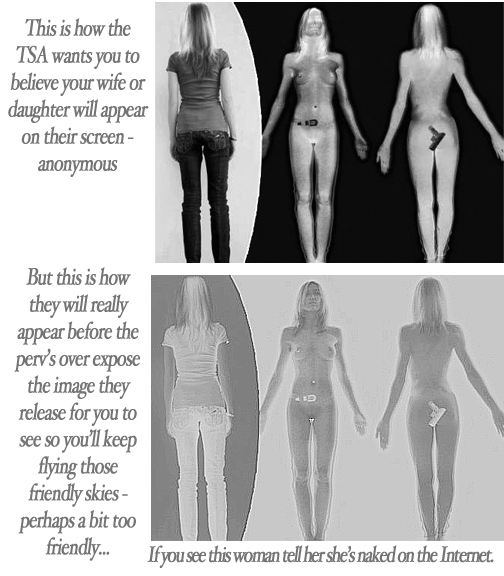
According to the TSA, the Whole Body Imagers do not reveal very much detail. The images are safe for Reader’s Digest and could even be posted in pre-schools. That is an exaggeration for even the downgraded images. That is an absurdity for the images that the Screener actually sees.
It is fascinating that these better images came out now. First the TSA had one of their security screening manuals leaked. Then they allowed the Nigerian crotch-bomber to fly – while it is true that the flight did not originate in the United States, the United States government received and approved the passenger list before the plane even took off. Then to respond the TSA harassed some bloggers and got caught. Then these more revealing images were released, including a video.
While Britain is undergoing a rather unfortunate bout of sex predator hysteria, causing parents to be considered suspects just for wanting to see their own kids in a school play, the hysteria there has had the beneficial side effect of having the government declare that the machines cannot be used on children. The TSA has admitted that minors are subject to full screening.
Finally, in spite of the many pronouncements about the medically safe millimeter wave technology being used, it appears that the TSA is also deploying unsafe X-Ray technology along side the millimeter wave technology, and that the person being screened is not likely to know which is being used. The only issues with millimeter wave technology are legal and constitutional. The only issues with X-Ray technology are legal, constitutional, and medical!
The TSA is being shown to the public for what it is, and it is ugly.
Friday, January 01, 2010
Social Creationism
A common accusation hurled at those who support a market without a central plan, is that of "Social Darwinism." The term is never explicitly defined in these particular cases, because a precise definition of the term renders it useless as any sort of attack against those who prefer markets that lack central plans.
But taking the critics of the free market at their words, hypothetically assuming there may be a basis to the epithet that is used in place of an argument, what exactly is the antithesis of Social Darwinism?
Since in the debates between science and religion the term "Darwinist" is used as an epithet against scientists by creationists, then would it not be proper to consider those who use the term "Social Darwinist" against free markets to be "Social Creationist"?
It may seem a silly line of reasoning, but consider the implications of "Social Creationism." It would imply that each person is born into a specific set social class and that the classes, like the species, are immutable. True, there may be "Micro Social Darwinism" where someone in the lower class can become a wealthier member of the lower class, and an aristocrat can fall upon hard times and become a less wealthy aristocrat, but no matter how wealthy a peasant is always a peasant and less of a person than the nobility. These roles are defined at the moment of creation and cannot be changed.
This fits very neatly with Marx' "class logic' where there was a 'proletarian logic' and a 'bourgeois logic'. One is a member of their class and it cannot be changed. In Marx' system, the different classes were inevitably at war and cannot be reconciled.
That is a point of view that also fits neatly with the pre-enlightenment mentality of nobility itself, that the peasants were beneath the nobility. Thus Aristocracy and Marxism are both Social Creationist philosophies.
It's an interesting mental exercise, and it would probably confound the person using "Social Darwinism" as an epithet if the rebuttal is to call the person a "Social Creationist."
But taking the critics of the free market at their words, hypothetically assuming there may be a basis to the epithet that is used in place of an argument, what exactly is the antithesis of Social Darwinism?
Since in the debates between science and religion the term "Darwinist" is used as an epithet against scientists by creationists, then would it not be proper to consider those who use the term "Social Darwinist" against free markets to be "Social Creationist"?
It may seem a silly line of reasoning, but consider the implications of "Social Creationism." It would imply that each person is born into a specific set social class and that the classes, like the species, are immutable. True, there may be "Micro Social Darwinism" where someone in the lower class can become a wealthier member of the lower class, and an aristocrat can fall upon hard times and become a less wealthy aristocrat, but no matter how wealthy a peasant is always a peasant and less of a person than the nobility. These roles are defined at the moment of creation and cannot be changed.
This fits very neatly with Marx' "class logic' where there was a 'proletarian logic' and a 'bourgeois logic'. One is a member of their class and it cannot be changed. In Marx' system, the different classes were inevitably at war and cannot be reconciled.
That is a point of view that also fits neatly with the pre-enlightenment mentality of nobility itself, that the peasants were beneath the nobility. Thus Aristocracy and Marxism are both Social Creationist philosophies.
It's an interesting mental exercise, and it would probably confound the person using "Social Darwinism" as an epithet if the rebuttal is to call the person a "Social Creationist."
Saturday, December 26, 2009
Obama is failing
Although Obama supporters continue to tell all doubters that it is far too early to judge whether Obama has been a successful president or not, and indicate that for the foreseeable future it will still be too early, there are indications that he has indeed become a failure in spite of all his good intentions.
There are two indicators that can be pointed at that show a weakening of support for Obama. The first is a Saturday Night Live skit featuring actors impersonating Barack Obama and Hu Jintao. This is the same show that did such a convincing impersonation of Sarah Palin that many Democrats actually think Palin said she could see Russia from her porch. The second is a week long series in Doonesbury in which Gary Trudeau, using the character Mark Slackmeyer as his mouth piece, has gone on a critical rampage against Obama's policy failings.
There are some groups that would never support Obama. Republicans never would for the same reason Republicans would never support any Democrat - they are in the hated other party. Crips hate Bloods and Bloods hate Crips. In spite of the insinuations, continued to the point of absurdity, that it is all about race, the simple truth is that Republicans won't support Obama because he's a Democrat.
Libertarians find that occasionally Obama appears that he might be willing to do things right, on very rare occasions, such as when he eventually got around to doing something about the war on drugs, but overall he is as much a disappointment as he was expected to be, that all the rhetoric about hope and change was to fool the gullible as most campaign promises are.
But those examples show voices that would normally be more supportive of Obama questioning their own president.
While the bailout has given the illusion of the recession being over, it is clear that the fundamental problems are not solved. The wars continue (as Obama promised) in spite of the hopes of his supporters that he would end them. Health care is in many ways a fiasco for the Democrats, as Obama campaigned on the public option and then stated he did not do so.
The year 2010 is going to be even worse economically than 2009. Will it still be too early to judge Obama?
There are two indicators that can be pointed at that show a weakening of support for Obama. The first is a Saturday Night Live skit featuring actors impersonating Barack Obama and Hu Jintao. This is the same show that did such a convincing impersonation of Sarah Palin that many Democrats actually think Palin said she could see Russia from her porch. The second is a week long series in Doonesbury in which Gary Trudeau, using the character Mark Slackmeyer as his mouth piece, has gone on a critical rampage against Obama's policy failings.
There are some groups that would never support Obama. Republicans never would for the same reason Republicans would never support any Democrat - they are in the hated other party. Crips hate Bloods and Bloods hate Crips. In spite of the insinuations, continued to the point of absurdity, that it is all about race, the simple truth is that Republicans won't support Obama because he's a Democrat.
Libertarians find that occasionally Obama appears that he might be willing to do things right, on very rare occasions, such as when he eventually got around to doing something about the war on drugs, but overall he is as much a disappointment as he was expected to be, that all the rhetoric about hope and change was to fool the gullible as most campaign promises are.
But those examples show voices that would normally be more supportive of Obama questioning their own president.
While the bailout has given the illusion of the recession being over, it is clear that the fundamental problems are not solved. The wars continue (as Obama promised) in spite of the hopes of his supporters that he would end them. Health care is in many ways a fiasco for the Democrats, as Obama campaigned on the public option and then stated he did not do so.
The year 2010 is going to be even worse economically than 2009. Will it still be too early to judge Obama?
Friday, December 18, 2009
No True Libertarian
"You say that your philosphy is strictly against any intervention in the economy. You say any intervention is a violation of your philosophy. Here is an intervention that I declare you like. If you disagree with me then you are engaging in the 'No True Scotsman' fallacy."
Everyone should be familiar with the "No True Scotsman" fallacy. It takes the form of someone denying that a potentially embarrassing member of a group is a member of a group at all. It is quite common in discussions of communism, where each and every despotic communist regime is said to be "not really communism." In rare occasions the defender of communist thought will try to label the system under discussion as capitalist because in the Soviet Union "there were a small number of rich people who owned and controlled everything and everyone else was poor."
"No True Scotsman" is useful for anyone who belongs to a group with active and vocal extremists committing acts that would embarrass the rest of the group. Communist regimes embarrass communists. The inquisition still embarrasses Christians.
But there is another fallacy, sort of a mirror image fallacy, that also comes into play. It is the "No True Libertarian" fallacy. It is not employed by members of the group under examination. It is employed by opponents of the group under examination. "You do not spit on the poor? You’re not a true libertarian." It gets its name because it was discovered in a debate in which someone who opposed libertarianism kept decrying his opponents of not being libertarian when they didn’t hold positions he said they should hold.
Various absurd positions that libertarians "should" take were brought up; embracing slavery, a willingness to turn family members into prostitutes, a desire to live in a world similar to "Mad Max" movies, etc. When people denied the extreme anti-libertarian positions, they were described as not real libertarians. And if libertarians point out that anti-libertarian positions are indeed not consistent with any form of libertarian thought, the anti-libertarians insist that means that libertarianism is nothing more than a pick and choose ideology.
So if a position that is inconsistent with libertarianism is said to be inconsistent with libertarianism, that means libertarianism is itself inconsistent?
According to all the attributes assigned to libertarians by those who oppose it, if one counts the number of libertarians who do not hold those ideas then there really are no true libertarians anywhere in the world.
Like last year, I urge people to give to the Salvation Army. As the economy worsens even more than last year, more people are in need of effective charity. I don't agree with them theologically, but I agree with the work they do. And since the FCC is asking us to reveal whether or not we receive any benefit from endorsements we make, it's none of their damn business.
Everyone should be familiar with the "No True Scotsman" fallacy. It takes the form of someone denying that a potentially embarrassing member of a group is a member of a group at all. It is quite common in discussions of communism, where each and every despotic communist regime is said to be "not really communism." In rare occasions the defender of communist thought will try to label the system under discussion as capitalist because in the Soviet Union "there were a small number of rich people who owned and controlled everything and everyone else was poor."
"No True Scotsman" is useful for anyone who belongs to a group with active and vocal extremists committing acts that would embarrass the rest of the group. Communist regimes embarrass communists. The inquisition still embarrasses Christians.
But there is another fallacy, sort of a mirror image fallacy, that also comes into play. It is the "No True Libertarian" fallacy. It is not employed by members of the group under examination. It is employed by opponents of the group under examination. "You do not spit on the poor? You’re not a true libertarian." It gets its name because it was discovered in a debate in which someone who opposed libertarianism kept decrying his opponents of not being libertarian when they didn’t hold positions he said they should hold.
Various absurd positions that libertarians "should" take were brought up; embracing slavery, a willingness to turn family members into prostitutes, a desire to live in a world similar to "Mad Max" movies, etc. When people denied the extreme anti-libertarian positions, they were described as not real libertarians. And if libertarians point out that anti-libertarian positions are indeed not consistent with any form of libertarian thought, the anti-libertarians insist that means that libertarianism is nothing more than a pick and choose ideology.
So if a position that is inconsistent with libertarianism is said to be inconsistent with libertarianism, that means libertarianism is itself inconsistent?
According to all the attributes assigned to libertarians by those who oppose it, if one counts the number of libertarians who do not hold those ideas then there really are no true libertarians anywhere in the world.
Like last year, I urge people to give to the Salvation Army. As the economy worsens even more than last year, more people are in need of effective charity. I don't agree with them theologically, but I agree with the work they do. And since the FCC is asking us to reveal whether or not we receive any benefit from endorsements we make, it's none of their damn business.
Sunday, December 13, 2009
What is a "good cop"?
There are no good police officers in the Portland Police Department of Portland, Oregon. Every single one of them is a "bad cop." Anyone who would pepper spray an eleven month old baby, or even do nothing when an eleven month old baby is pepper sprayed, is not only a bad cop but is no longer even remotely human.
Too many people have too relaxed a definition of "good cop". To them, a good cop is one who is not engaging in criminal activity. However, since a police officer's job is to apprehend those who are engaging in criminal activity, any officer who does not do that is by definition a bad cop. That includes failure to arrest fellow officers when fellow officers break the law.
There are no good cops in New York City Police Department. The officer who assaulted the critical mass cyclist was clearly a bad cop, but there were several other officers who stood around doing nothing when that happened. They did not arrest their fellow officer. Instead they initially corroborated his story, until a YouTube video gave lie to their version of events.
Given how increasingly criminal the police are acting, it is important to remember that just because a police officer does not personally break the law, it does not mean that officer is good. By failing to act they give consent to the actions of their fellow officers. For anyone short of an officer of the law, simply not breaking the law may be considered a valid definition, but police officers must be held to a higher standard due to the nature of their voluntarily chosen occupation.
There are no good cops in The Utah Highway Patrol. Instead they cleared the officer of all wrong-doing for using pain compliance and electroshock torture for someone who was not posing any sort of threat, but not giving abject obsequience to the officer either. If there was a single good cop in the whole organization, then Trooper Gardner would have been arrested for assault.
When the police start arresting the many bad apples within their own ranks, then it can be said there are good cops. Until that time their numbers are distressingly few.
Like last year, I urge people to give to the Salvation Army. As the economy worsens even more than last year, more people are in need of effective charity. I don't agree with them theologically, but I agree with the work they do. And since the FCC is asking us to reveal whether or not we receive any benefit from endorsements we make, it's none of their damn business.
Too many people have too relaxed a definition of "good cop". To them, a good cop is one who is not engaging in criminal activity. However, since a police officer's job is to apprehend those who are engaging in criminal activity, any officer who does not do that is by definition a bad cop. That includes failure to arrest fellow officers when fellow officers break the law.
There are no good cops in New York City Police Department. The officer who assaulted the critical mass cyclist was clearly a bad cop, but there were several other officers who stood around doing nothing when that happened. They did not arrest their fellow officer. Instead they initially corroborated his story, until a YouTube video gave lie to their version of events.
Given how increasingly criminal the police are acting, it is important to remember that just because a police officer does not personally break the law, it does not mean that officer is good. By failing to act they give consent to the actions of their fellow officers. For anyone short of an officer of the law, simply not breaking the law may be considered a valid definition, but police officers must be held to a higher standard due to the nature of their voluntarily chosen occupation.
There are no good cops in The Utah Highway Patrol. Instead they cleared the officer of all wrong-doing for using pain compliance and electroshock torture for someone who was not posing any sort of threat, but not giving abject obsequience to the officer either. If there was a single good cop in the whole organization, then Trooper Gardner would have been arrested for assault.
When the police start arresting the many bad apples within their own ranks, then it can be said there are good cops. Until that time their numbers are distressingly few.
Like last year, I urge people to give to the Salvation Army. As the economy worsens even more than last year, more people are in need of effective charity. I don't agree with them theologically, but I agree with the work they do. And since the FCC is asking us to reveal whether or not we receive any benefit from endorsements we make, it's none of their damn business.
Saturday, December 05, 2009
What is the free market?
"You believe the free market will take care of it."
Actually, no.
The person uttering that phrase is making an unwarranted assumption, that the free market is a centrally planned economic system just like all the others. The difference being that the person is implying that the free market is an independent self-aware quasi-omnipotent entity that does the central planning.
What "the free market" actually is, is the lack of any central planning. That's all it is. It is not an alternate method of organizing the economy. It is not replacing a physical central planner with an intangible central planner. It is simply the lack of a method of organizing the economy, the lack of a central planner. It is the millions of individuals engaging in billions of interactions and making trillions of decisions, all without being told what to do by some third party.
Given what the free market actually is, when someone is accused of trusting the free market, what that person is actually trusting is each individual to make his own decisions. Someone who "trusts the free market" trusts the people to act on their own behalf in their own best interest within the confines of their own knowledge.
The only people not trusted by someone who trusts "the free market" are those that say "I am equipped to make decisions for you." That person is a central planner, and the free market is only the lack of a central plan. Many people like that are unable to comprehend the absense of any central plan, which is why they must identify some kind of planner, somehow, in the free market, even if they have to make it up.
Like last year, I urge people to give to the Salvation Army. As the economy worsens even more than last year, more people are in need of effective charity. I don't agree with them theologically, but I agree with the work they do. And since the FCC is asking us to reveal whether or not we receive any benefit from endorsements we make, it's none of their damn business.
Actually, no.
The person uttering that phrase is making an unwarranted assumption, that the free market is a centrally planned economic system just like all the others. The difference being that the person is implying that the free market is an independent self-aware quasi-omnipotent entity that does the central planning.
What "the free market" actually is, is the lack of any central planning. That's all it is. It is not an alternate method of organizing the economy. It is not replacing a physical central planner with an intangible central planner. It is simply the lack of a method of organizing the economy, the lack of a central planner. It is the millions of individuals engaging in billions of interactions and making trillions of decisions, all without being told what to do by some third party.
Given what the free market actually is, when someone is accused of trusting the free market, what that person is actually trusting is each individual to make his own decisions. Someone who "trusts the free market" trusts the people to act on their own behalf in their own best interest within the confines of their own knowledge.
The only people not trusted by someone who trusts "the free market" are those that say "I am equipped to make decisions for you." That person is a central planner, and the free market is only the lack of a central plan. Many people like that are unable to comprehend the absense of any central plan, which is why they must identify some kind of planner, somehow, in the free market, even if they have to make it up.
Like last year, I urge people to give to the Salvation Army. As the economy worsens even more than last year, more people are in need of effective charity. I don't agree with them theologically, but I agree with the work they do. And since the FCC is asking us to reveal whether or not we receive any benefit from endorsements we make, it's none of their damn business.
Sunday, November 29, 2009
Lack Friday
It is time for the Keynesian economists to predict disaster in spite of their pronouncements that the economy was finally recovering. They announced a fragile recovery and a jobless recovery. Then "Black Friday" failed to occur. The single biggest shopping day of the year happened without the massive crowds normally associated with that day.
Retailers were reporting that conditions were basically the same as any normal business day, and that by early evening the stores were fairly deserted. Although there were shoppers seeking good deals on high end items, it appeared that they were shopping for replacements for worn appliances, and not purchasing items like plasma televisions and other luxury consumer goods.
As is preached by Austrian economists, people are saving their money because they are in a recession. Many businesses look forward to "Black Friday" and the rest of the holiday season, as Christmas shopping helps sustain the businesses through the rest of the year. If the 2009 Christmas season fails to provide the profits usually associated with Christmas shopping many of the businesses that depend on it may not make it through the rest of the year.
The Keynesian solution is more stimulus. The message among those in political circles will be that people aren't spending enough.
People are saving money because it is the sensible thing to do, especially in economic hard time. The official unemployment rate is around 10%, the unofficial (and more accurate) rate is aroudn 20%, and the rate among 18 - 30 year olds is 50%. The money isn't there to be spent. Going further into debt is the very last thing peole need to do right now, even if the banks were lending.
If "Black Friday" i an indication of things to come, the situation is more accurately described as "Lack Friday". First the stores will lack customers, and then thanks to government efforts to remedy the situation the people will lack money and freedom.
Retailers were reporting that conditions were basically the same as any normal business day, and that by early evening the stores were fairly deserted. Although there were shoppers seeking good deals on high end items, it appeared that they were shopping for replacements for worn appliances, and not purchasing items like plasma televisions and other luxury consumer goods.
As is preached by Austrian economists, people are saving their money because they are in a recession. Many businesses look forward to "Black Friday" and the rest of the holiday season, as Christmas shopping helps sustain the businesses through the rest of the year. If the 2009 Christmas season fails to provide the profits usually associated with Christmas shopping many of the businesses that depend on it may not make it through the rest of the year.
The Keynesian solution is more stimulus. The message among those in political circles will be that people aren't spending enough.
People are saving money because it is the sensible thing to do, especially in economic hard time. The official unemployment rate is around 10%, the unofficial (and more accurate) rate is aroudn 20%, and the rate among 18 - 30 year olds is 50%. The money isn't there to be spent. Going further into debt is the very last thing peole need to do right now, even if the banks were lending.
If "Black Friday" i an indication of things to come, the situation is more accurately described as "Lack Friday". First the stores will lack customers, and then thanks to government efforts to remedy the situation the people will lack money and freedom.
Sunday, November 22, 2009
Economics for Scientists
The relationship between the social sciences and the natural sciences has always been a little strained, with social sciences constantly seeking the approval of the natural sciences. The social sciences cannot use the same methodology as the natural sciences, which causes too many natural scientists to look on the social sciences as having little to value.
That is not to say that all social sciences suffer from this problem. The sciences of anthropology and archaeology are quite well accepted, and psychology mostly so, but too far beyond that and the value, as seen by a natural scientist, diminishes rapidly.
Some of the fault for this does lie in the social sciences themselves. If one is to study psychology, the basic courses are more of a history of psychology, where each theory is studied, and then the refutation by the competing school is offered. An equivalent in the natural sciences would be for a physicist to have to study phlogiston and for a biologist to have to study the four humours. They are valuable in a history of science class, but have no actual value to someone seeking to learn science now.
Some in the social sciences feel the problem is that the issues studied aren't expressed mathematically. This is the solution adopted by Keynesians, and since that ideology is currently dominant other economists who wish official approval adopt the practice of trying to express everything in number. This includes some factors that cannot accurately be measured, such as "consumer confidence" or "satisfaction."
There is an aspect to Keynesian economics that would appeal to engineers, in that the Keynesian economic model present society as a machine, and if a certain input is inserted at one end a certain end result comes out of the other. But that alone doesn’t make Keynesian economics scientific.
The underlying basis of science is "does it work." That may sound like a strange stipulation to a person who read "Pragmatic Politics" but unlike the pseudo-pragmatists, when a scientist says "does it work" the scientist is operating from a specific premise. "Pragmatic Politics" also argued that any time someone asks that question they person asking it is acting from a particular premise of what goal the person asking it is trying to achieve. In the case of the scientist, the goal is a theory that accurately describes the real world and can be used to make accurate predictions.
It is said that when Einstein had finished developing his theories, he was quite distressed that as a consequence of his formulas black holes were predicted. He checked his work many times, but eventually came to the conclusion that the data said what the data said. As much as he personally disliked the idea of black holes, the theory was meant to reflect the world and he had to accept it as it was. Later on corroborating evidence was found that showed the mathematics were correct.
That is what made his theories scientific. They were designed to reflect the world, not the way he wished the world to be. They made predictions that could be tested. And unlike the theories that were replaced by Einstein’s theories, the tests showed that the theories accurately modeled the world.
All the currently competing schools of economics make predictions. Keynesian economics predicts that manipulation of aggregate demand can lead to a prosperous economy. Monetarist economics predicts that manipulation of the money supply can lead to a prosperous economy. And both of those have been discredited by events. If a theory is supposed to model the real world, then neither Keynesianism nor Monetarism are theories.
Once a theory has been discredited by the data, continuing to hold to that theory is no longer scientific but an act of faith.
Austrian economics, however, has been validated by events. Although it lacks the mathematics that many consider to be necessary for a scientific theory, an honest analysis shows that the predictions have been accurate. Since it is not the mathematics but the predictive power of a theory that makes it scientific, that means that Austrian economics is indeed a scientific theory of economics.
Although there are those scientists who might initially find it unappealing, if they emulate Einstein they will reluctantly embrace it because of its verified predictive power in spite of whatever political ideology they hold.
That is not to say that all social sciences suffer from this problem. The sciences of anthropology and archaeology are quite well accepted, and psychology mostly so, but too far beyond that and the value, as seen by a natural scientist, diminishes rapidly.
Some of the fault for this does lie in the social sciences themselves. If one is to study psychology, the basic courses are more of a history of psychology, where each theory is studied, and then the refutation by the competing school is offered. An equivalent in the natural sciences would be for a physicist to have to study phlogiston and for a biologist to have to study the four humours. They are valuable in a history of science class, but have no actual value to someone seeking to learn science now.
Some in the social sciences feel the problem is that the issues studied aren't expressed mathematically. This is the solution adopted by Keynesians, and since that ideology is currently dominant other economists who wish official approval adopt the practice of trying to express everything in number. This includes some factors that cannot accurately be measured, such as "consumer confidence" or "satisfaction."
There is an aspect to Keynesian economics that would appeal to engineers, in that the Keynesian economic model present society as a machine, and if a certain input is inserted at one end a certain end result comes out of the other. But that alone doesn’t make Keynesian economics scientific.
The underlying basis of science is "does it work." That may sound like a strange stipulation to a person who read "Pragmatic Politics" but unlike the pseudo-pragmatists, when a scientist says "does it work" the scientist is operating from a specific premise. "Pragmatic Politics" also argued that any time someone asks that question they person asking it is acting from a particular premise of what goal the person asking it is trying to achieve. In the case of the scientist, the goal is a theory that accurately describes the real world and can be used to make accurate predictions.
It is said that when Einstein had finished developing his theories, he was quite distressed that as a consequence of his formulas black holes were predicted. He checked his work many times, but eventually came to the conclusion that the data said what the data said. As much as he personally disliked the idea of black holes, the theory was meant to reflect the world and he had to accept it as it was. Later on corroborating evidence was found that showed the mathematics were correct.
That is what made his theories scientific. They were designed to reflect the world, not the way he wished the world to be. They made predictions that could be tested. And unlike the theories that were replaced by Einstein’s theories, the tests showed that the theories accurately modeled the world.
All the currently competing schools of economics make predictions. Keynesian economics predicts that manipulation of aggregate demand can lead to a prosperous economy. Monetarist economics predicts that manipulation of the money supply can lead to a prosperous economy. And both of those have been discredited by events. If a theory is supposed to model the real world, then neither Keynesianism nor Monetarism are theories.
Once a theory has been discredited by the data, continuing to hold to that theory is no longer scientific but an act of faith.
Austrian economics, however, has been validated by events. Although it lacks the mathematics that many consider to be necessary for a scientific theory, an honest analysis shows that the predictions have been accurate. Since it is not the mathematics but the predictive power of a theory that makes it scientific, that means that Austrian economics is indeed a scientific theory of economics.
Although there are those scientists who might initially find it unappealing, if they emulate Einstein they will reluctantly embrace it because of its verified predictive power in spite of whatever political ideology they hold.
Saturday, November 14, 2009
One Healthcare Reform
Proponents of the current healthcare reform proposal in congress like to accuse critics of not offering any alternatives, of only opposing without offering anything. While that accusation is completely not true, it serve proponents of the fascist system well as a big lie, just as calling it socialist instead of fascist serves as another convenient lie.
Rather than dissect any particular part of the fascist bill, a refutation of the false charge that critics offer nothing is also useful. The reason the proponents say that critics offer nothing is because only big government solutions are allowed to be considered. Anything else is not a "constructive proposal" and thus they can get away with that big lie.
In spite of the psychological block against small government proposals being considered, it is always useful to suggest as many small government solutions as possible. That way the next time someone says that critics of fascist health care never offer solutions the critics can respond with "look at all the solutions I've offered that you refuse to consider."
Given the large number of problems, any single solution fails to address the full problem and appears short sighted. But one aspect is all that can be addressed at once.
One of the problems with the current system is that the patient is not the customer. When a doctor treats a patient, the patient isn't the customer. The insurance pays for the visit, and so the insurance is the customer. And who is the insurance company's customer? Since most people get their insurance through their employer, the employer is the customer and not the employee. It is true that sufficient employee complaints can cause an employer to switch companies, but the customer of the insurance company is the employer.
For a truly responsive insurance company, the patient needs to be the customer of the insurance company. For truly responsive health care, the patient needs to be the customer of the doctor. The only remaining question of this particular solution is how to make it possible. As proponents of fascist health care are quick to point out, the average person cannot afford a catastrophic illness.
The first part of the solution is to transfer the tax incentive for the purchase of health insurance from the employer to the employee. That way, unlike the Obama plan, people have a positive encouragement to purchase insurance instead of a punishment for failure to purchase insurance. Persuasion always being preferable to force, encouraging people to purchase insurance instead of punishing them for failure to purchase insurance is a better solution.
To make insurance affordable enough for a person to purchase it, the price needs to be brought down. That can be done through coercion or through encouragement. To do it through encouragement the best way to do it is through removing the rules that prohibit insurance companies from competing across state lines. Putting individual insurance policies in the hand of the customers while simultaneously increasing the number of companies and policies available, while giving people a tax break for purchasing insurance, will drive down the cost to the point where most people can afford it.
Another way to make insurance affordable is to remember that insurance is supposed to be for the unusual event. The way health insurance currently operates is absurd - it is comparable to using automobile insurance to pay for basic tune-ups, or even to pay for putting gas in the car.
Analyzing a standard insurance statement or doctor's visit statement, one finds that in general a large portion of a standard bill is an insurance negotiated adjustment. Another large portion is the patient co-pay. The smallest part is the payment the insurance company makes to the doctor. Ask most doctors what their cash price is and it turns out it is actually lower than the stated price for a visit.
People need to pay directly for office visits, and a good way to do that is through tax deductible healthcare savings accounts. But not the HSAs currently in use, that have an end of year use-or-lose for the funds. What is needed is a roll-over HSA, that allows people to put in more funds than needed while healthy so that the funds will be there many years later when people need more healthcare funds. This is similar to using a retirement savings account. In order to encourage use of a roll-over HSA account funds put into it should be tax free, just as in the current annual HSA.
That will give our current healthcare system another thirty years of operation before it gets as bad as it currently is.
Rather than dissect any particular part of the fascist bill, a refutation of the false charge that critics offer nothing is also useful. The reason the proponents say that critics offer nothing is because only big government solutions are allowed to be considered. Anything else is not a "constructive proposal" and thus they can get away with that big lie.
In spite of the psychological block against small government proposals being considered, it is always useful to suggest as many small government solutions as possible. That way the next time someone says that critics of fascist health care never offer solutions the critics can respond with "look at all the solutions I've offered that you refuse to consider."
Given the large number of problems, any single solution fails to address the full problem and appears short sighted. But one aspect is all that can be addressed at once.
One of the problems with the current system is that the patient is not the customer. When a doctor treats a patient, the patient isn't the customer. The insurance pays for the visit, and so the insurance is the customer. And who is the insurance company's customer? Since most people get their insurance through their employer, the employer is the customer and not the employee. It is true that sufficient employee complaints can cause an employer to switch companies, but the customer of the insurance company is the employer.
For a truly responsive insurance company, the patient needs to be the customer of the insurance company. For truly responsive health care, the patient needs to be the customer of the doctor. The only remaining question of this particular solution is how to make it possible. As proponents of fascist health care are quick to point out, the average person cannot afford a catastrophic illness.
The first part of the solution is to transfer the tax incentive for the purchase of health insurance from the employer to the employee. That way, unlike the Obama plan, people have a positive encouragement to purchase insurance instead of a punishment for failure to purchase insurance. Persuasion always being preferable to force, encouraging people to purchase insurance instead of punishing them for failure to purchase insurance is a better solution.
To make insurance affordable enough for a person to purchase it, the price needs to be brought down. That can be done through coercion or through encouragement. To do it through encouragement the best way to do it is through removing the rules that prohibit insurance companies from competing across state lines. Putting individual insurance policies in the hand of the customers while simultaneously increasing the number of companies and policies available, while giving people a tax break for purchasing insurance, will drive down the cost to the point where most people can afford it.
Another way to make insurance affordable is to remember that insurance is supposed to be for the unusual event. The way health insurance currently operates is absurd - it is comparable to using automobile insurance to pay for basic tune-ups, or even to pay for putting gas in the car.
Analyzing a standard insurance statement or doctor's visit statement, one finds that in general a large portion of a standard bill is an insurance negotiated adjustment. Another large portion is the patient co-pay. The smallest part is the payment the insurance company makes to the doctor. Ask most doctors what their cash price is and it turns out it is actually lower than the stated price for a visit.
People need to pay directly for office visits, and a good way to do that is through tax deductible healthcare savings accounts. But not the HSAs currently in use, that have an end of year use-or-lose for the funds. What is needed is a roll-over HSA, that allows people to put in more funds than needed while healthy so that the funds will be there many years later when people need more healthcare funds. This is similar to using a retirement savings account. In order to encourage use of a roll-over HSA account funds put into it should be tax free, just as in the current annual HSA.
That will give our current healthcare system another thirty years of operation before it gets as bad as it currently is.
Saturday, November 07, 2009
The empire cripples itself
Recently there was a story in the Army Times about how youths in the United States are generally unfit for military service. Too many potential recruits are either insufficiently educated, physically unfit, or have criminal records.
It is quite interesting because these youths are the products of government run taxpayer funded schools. Theoretically the government would want a population that is fit enough for military service, and as such would ensure the government run schools would provide a population that is smart enough, fit enough, and motivated enough to serve in the military.
This is one of the fundamental flaws of empire. On the one hand empire needs a population that is fit, intelligent, and motivated, so that these people can serve in ways necessary to administer the empire over other people. On the other hand, due to the repressive nature of empires back home, the empire needs a population that is under-informed, docile, and apathetic. It is very difficult to achieve both of those goals at the same time.
It is true that there is a way out of the dilemma, and that is to have a very militaristic educational system that emphasizes obedience above all else while educating in the basics of reading, writing, and arithmetic. But that is not what happened in the United States. With the emphasis being on not educating the public, the result is a public that is functionally illiterate. Michael Jackson’s funeral has more public interest than Ron Paul’s Audit the Fed bill.
It’s clear that the emphasis isn’t on education, even though nobody in the education system (other than John Taylor Gatto) will ever admit to such. It is clear because you hear complaints about “teaching to the test” and complaints about people entering the work force unqualified. Many college have a basic skills department to remedy the lack in even reading and arithmetic among entering students. If there really was a desire among the leadership in this country to produce an educated public, it could be accomplished, so therefore one must logically conclude that desire is not there.
Small wonder that among those who do seek employ in the government, too many of them are more than willing to abuse their position instead of think about the responsibilities of their position. More and more it is becoming apparent that while prosecutors have the necessary specialized knowledge of law to perform their job they have no knowledge about the philosophy of the laws they enforce and never stop to consider the ethics of their actions. More and more it is becoming apparent that too many police are no longer different from the criminals they are supposed to stop and are instead merely criminals with official permission to act. Just as the education system fails to provide soldiers, it fails to provide police.
Among the fields that require extensive thought, many of the engineering and medical students in this country are students who grew up in foreign countries and are now studying in the United States. Engineers and doctors study the humanities, but very few in politics have studied even the rudiments of science.
An empire will fail either because the public will not tolerate the domestic abuses needed to maintain an empire abroad, or because the public is too apathetic or unfit to maintain the empire abroad. It is clear which of these two paths has been chosen by the United States government.
It is quite interesting because these youths are the products of government run taxpayer funded schools. Theoretically the government would want a population that is fit enough for military service, and as such would ensure the government run schools would provide a population that is smart enough, fit enough, and motivated enough to serve in the military.
This is one of the fundamental flaws of empire. On the one hand empire needs a population that is fit, intelligent, and motivated, so that these people can serve in ways necessary to administer the empire over other people. On the other hand, due to the repressive nature of empires back home, the empire needs a population that is under-informed, docile, and apathetic. It is very difficult to achieve both of those goals at the same time.
It is true that there is a way out of the dilemma, and that is to have a very militaristic educational system that emphasizes obedience above all else while educating in the basics of reading, writing, and arithmetic. But that is not what happened in the United States. With the emphasis being on not educating the public, the result is a public that is functionally illiterate. Michael Jackson’s funeral has more public interest than Ron Paul’s Audit the Fed bill.
It’s clear that the emphasis isn’t on education, even though nobody in the education system (other than John Taylor Gatto) will ever admit to such. It is clear because you hear complaints about “teaching to the test” and complaints about people entering the work force unqualified. Many college have a basic skills department to remedy the lack in even reading and arithmetic among entering students. If there really was a desire among the leadership in this country to produce an educated public, it could be accomplished, so therefore one must logically conclude that desire is not there.
Small wonder that among those who do seek employ in the government, too many of them are more than willing to abuse their position instead of think about the responsibilities of their position. More and more it is becoming apparent that while prosecutors have the necessary specialized knowledge of law to perform their job they have no knowledge about the philosophy of the laws they enforce and never stop to consider the ethics of their actions. More and more it is becoming apparent that too many police are no longer different from the criminals they are supposed to stop and are instead merely criminals with official permission to act. Just as the education system fails to provide soldiers, it fails to provide police.
Among the fields that require extensive thought, many of the engineering and medical students in this country are students who grew up in foreign countries and are now studying in the United States. Engineers and doctors study the humanities, but very few in politics have studied even the rudiments of science.
An empire will fail either because the public will not tolerate the domestic abuses needed to maintain an empire abroad, or because the public is too apathetic or unfit to maintain the empire abroad. It is clear which of these two paths has been chosen by the United States government.
Saturday, October 31, 2009
Bush the Socialist, Obama the Fascist
Sometime in the early 1980s the colors used to represent the two primary political parties swapped. For many years the Republicans were represented by the color Blue and the Democrats were represented by the color Red. In a way that made sense, as the Republicans were portrayed as the Blue Bloods, the "aristocracy", while the Democrats were portrayed as the ones soft on Communism.
For reasons unknown the parties switched colors, to the point where few remember that they had the other colors as recently as 1980. Now saying a state is a "Red State" is a way to indicate that it is strongly Republican or conservative.
But events since the year 2000 would lead one to conclude that perhaps the switch in colors is accurate to some extent. Bush is clearly more socialist than Obama, and Obama is clearly more fascist than Bush. It should be noted at this point that there are many purists who insist that "Socialism" can only and ever refer to ownership of the means of production, and that wealth redistribution through other means - such as welfare - doesn't count as socialism. For the sake of argument, wealth redistribution will be referred to as "welfare socialism", and from this point on any reference to "socialism" will actually refer to "welfare socialism."
More than once during the Bush presidency efforts were made to avoid economic problems through bailouts. The interesting point is that more than once Bush had checks made out directly to the people. They were not large checks, about $300 per person, but he ordered them issued directly from the treasury to the public. Keynesian advisors warned against this on the grounds that the money might be wasted on foolish expenditures such as paying off credit cards or paying other bills. That did not deter Bush in his effort to strengthen the ailing economy through efforts aimed at the common man.
While both Bush and Obama gave money directly to failing banks, Obama has only given money to the failing banks and automobile companies. A common Republican quip has been "Where's my bailout?" to show that Obama is only giving money to the wealthiest of the public, not to the common person.
On healthcare the same pattern holds. Bush authorized the largest expansion of Medicare ever, with Perscription Drug Coverage for Seniors. Obama appears ready to jettison the "public option" in favor of mandating that everyone purchase health insurance.
Little wonder there is such discontent between the base and the party leadership in the Republican Party today, that a third party candidate may win the 23rd Congressional District in New York. Likewise the anti-war movement has little to be happy about with Obama, and Fascists are well known for their militancy.
For reasons unknown the parties switched colors, to the point where few remember that they had the other colors as recently as 1980. Now saying a state is a "Red State" is a way to indicate that it is strongly Republican or conservative.
But events since the year 2000 would lead one to conclude that perhaps the switch in colors is accurate to some extent. Bush is clearly more socialist than Obama, and Obama is clearly more fascist than Bush. It should be noted at this point that there are many purists who insist that "Socialism" can only and ever refer to ownership of the means of production, and that wealth redistribution through other means - such as welfare - doesn't count as socialism. For the sake of argument, wealth redistribution will be referred to as "welfare socialism", and from this point on any reference to "socialism" will actually refer to "welfare socialism."
More than once during the Bush presidency efforts were made to avoid economic problems through bailouts. The interesting point is that more than once Bush had checks made out directly to the people. They were not large checks, about $300 per person, but he ordered them issued directly from the treasury to the public. Keynesian advisors warned against this on the grounds that the money might be wasted on foolish expenditures such as paying off credit cards or paying other bills. That did not deter Bush in his effort to strengthen the ailing economy through efforts aimed at the common man.
While both Bush and Obama gave money directly to failing banks, Obama has only given money to the failing banks and automobile companies. A common Republican quip has been "Where's my bailout?" to show that Obama is only giving money to the wealthiest of the public, not to the common person.
On healthcare the same pattern holds. Bush authorized the largest expansion of Medicare ever, with Perscription Drug Coverage for Seniors. Obama appears ready to jettison the "public option" in favor of mandating that everyone purchase health insurance.
Little wonder there is such discontent between the base and the party leadership in the Republican Party today, that a third party candidate may win the 23rd Congressional District in New York. Likewise the anti-war movement has little to be happy about with Obama, and Fascists are well known for their militancy.
Saturday, October 24, 2009
What can I do?
It is a common question that haunts anyone who wants to increase liberty. When looking at all the ways government is advancing and liberty is diminishing, it is tempting to give in to despair. It is true that there is little that one person can do. Any large scale changes will involve large group efforts, true. So should a person give up and wait for said group efforts?
No, there is no reason to give in to despair. There is no reason to give up. There is still something that can be done. One can be prepared to ride the depression out and come out and prepare to come out on the other side.
The first thing to do is make sure that one is not fooled by the official propaganda. Anyone who has an evidence based view of economics knows that the current depression has utterly disproven Keynesian and Monetarist economics and vindicated Austrian economics. In spite of that, government economists and major media economists continue with the party line about government managed economies.
Keeping the facts in mind reveals that this is the worst time to sell gold for cash and to get further into debt. In spite of pronouncements that the depression is over, it is clear that the money pumped into the economy has done nothing more than re-inflated a few bubbles and paid off the major bankers. Using the knowledge gained by Austrian Economics, it is much easier to avoid the remaining bubbles.
Individually, the only thing a person can do is ensure his own house is in order. That's why many people advise starting a farm and other common sense measures.
Given how the police have gotten more dangerous, the best plan is not to confront them but to stay out of their sight as much as possible. Any talking back, even if in the right, is considered "contempt of cop" and results in an arrest for "disorderly conduct". A lucky person won't be tasered during the arrest for the crime of saying "what am I being arrested for?"
Of course, be armed, be ready to defend yourself. Be as prepared as possible for the various emergencies that may come up if the predictions of Austrian Economists continue to come to pass as they have done to this point. The only way to act to advance liberty is if the activist is able to act in the first place.
No, there is no reason to give in to despair. There is no reason to give up. There is still something that can be done. One can be prepared to ride the depression out and come out and prepare to come out on the other side.
The first thing to do is make sure that one is not fooled by the official propaganda. Anyone who has an evidence based view of economics knows that the current depression has utterly disproven Keynesian and Monetarist economics and vindicated Austrian economics. In spite of that, government economists and major media economists continue with the party line about government managed economies.
Keeping the facts in mind reveals that this is the worst time to sell gold for cash and to get further into debt. In spite of pronouncements that the depression is over, it is clear that the money pumped into the economy has done nothing more than re-inflated a few bubbles and paid off the major bankers. Using the knowledge gained by Austrian Economics, it is much easier to avoid the remaining bubbles.
Individually, the only thing a person can do is ensure his own house is in order. That's why many people advise starting a farm and other common sense measures.
Given how the police have gotten more dangerous, the best plan is not to confront them but to stay out of their sight as much as possible. Any talking back, even if in the right, is considered "contempt of cop" and results in an arrest for "disorderly conduct". A lucky person won't be tasered during the arrest for the crime of saying "what am I being arrested for?"
Of course, be armed, be ready to defend yourself. Be as prepared as possible for the various emergencies that may come up if the predictions of Austrian Economists continue to come to pass as they have done to this point. The only way to act to advance liberty is if the activist is able to act in the first place.
Saturday, October 17, 2009
The Is / Ought Fallacy
"Without Taxes, how will we pay for roads and schools and medical care?"
It is a common enough question whenever someone objects, not just to all taxes as is proper to do, not just to the current level which is excessive to all minarchists and many other thinking people, but even to proposed increases in taxes which will be used to fund new programs.
At first glance it appears to be an application of the Statist Fallacy, there is also another fallacy at play here, the Is / Ought fallacy. It is a Statist Fallacy because the assumption is that if the government doesn't provide these services than nobody will, and that by opposing the government being the provider of these services one also opposes the services being provided at all.
But it is also an is / ought fallacy. The speaker is assuming that the way things are, that the government provides these services, is the way things ought to be, and by expressing the point in that particular way the speaker is hoping to lay a verbal trap for any opponent of expanded government. One can either deny that taxes should pay for those and because of the statist fallacy agree that those should not exist, or one can agree that those services are valuable and because of the is / ought fallacy agree that the government should fund them.
A good answer is "since currently those are paid for by taxes, we currently need taxes to pay for those" and then immediately accuse the speaker of engaging in the is / ought fallacy. The inclusion of the word "currently", twice in one answer, allows the libertarian in the argument to sidestep the trap of either embracing the statist fallacy or the is / ought fallacy, and it becomes very difficult for even a determined statist to pull a quote out of context. Leaving out either instance of that word eases decontextualization and the ability to try to argue that the libertarian is actually agreeing on some level with the statist.
"Since currently those are paid for by taxes, we currently need taxes to pay for those. What a fine example of the is / ought fallacy, where since that is the way it is therefore that is the way it ought to be. Why ought it be that way? Is there no other way to fund those besides taxes?"
It is a common enough question whenever someone objects, not just to all taxes as is proper to do, not just to the current level which is excessive to all minarchists and many other thinking people, but even to proposed increases in taxes which will be used to fund new programs.
At first glance it appears to be an application of the Statist Fallacy, there is also another fallacy at play here, the Is / Ought fallacy. It is a Statist Fallacy because the assumption is that if the government doesn't provide these services than nobody will, and that by opposing the government being the provider of these services one also opposes the services being provided at all.
But it is also an is / ought fallacy. The speaker is assuming that the way things are, that the government provides these services, is the way things ought to be, and by expressing the point in that particular way the speaker is hoping to lay a verbal trap for any opponent of expanded government. One can either deny that taxes should pay for those and because of the statist fallacy agree that those should not exist, or one can agree that those services are valuable and because of the is / ought fallacy agree that the government should fund them.
A good answer is "since currently those are paid for by taxes, we currently need taxes to pay for those" and then immediately accuse the speaker of engaging in the is / ought fallacy. The inclusion of the word "currently", twice in one answer, allows the libertarian in the argument to sidestep the trap of either embracing the statist fallacy or the is / ought fallacy, and it becomes very difficult for even a determined statist to pull a quote out of context. Leaving out either instance of that word eases decontextualization and the ability to try to argue that the libertarian is actually agreeing on some level with the statist.
"Since currently those are paid for by taxes, we currently need taxes to pay for those. What a fine example of the is / ought fallacy, where since that is the way it is therefore that is the way it ought to be. Why ought it be that way? Is there no other way to fund those besides taxes?"
Friday, October 09, 2009
Traffic Lights
There is an anti-libertarian argument that, no matter how often refuted, comes up often and proceeds along these lines: Some order is necessary, such as traffic lights and speed limits. Libertarians would want to do away with traffic lights and speed limits because the government put them in place, even thought the government did so to keep us from killing each other while driving. You need some order to function as a society.
There are many errors contained in that one argument.
First of all, it is not the position of any consistent libertarian that the government should not be able to set rules for traffic on any government road. It’s simply a matter of application of property rights. A libertarian could easily defend traffic regulation by saying “whereas the government is the owner of the roads, the government has the authority to set the terms for the use of the roads.” A much more consistent libertarian argument would simply include one more word and say “whereas unfortunately the government is the owner of the roads, the government has the authority to set the terms for the use of the roads.” This argument is valid even for those who do not recognize the legitimacy of government ownership of anything because de facto the government owns them whether the legitimacy of the ownership is recognized or not.
But that does not address the deeper misunderstanding. Libertarianism is not, and never has been, against order. Libertarianism is merely opposed to externally imposed order, order brought to society at the point of a gun. Libertarians have long endorsed spontaneous order, the order that can be found inside chaotic systems such as the free market. The accusation of objection to order at all is a red herring, designed to throw people off of finding out what it is that libertarians are really objecting to.
Libertarians do not object to voluntary cooperation. In fact, for the free market (advocated by all libertarians) to function voluntary cooperation is a necessity. Buyer and seller are cooperating voluntarily, from the level of the smallest hot-dog vendor on the sidewalk and his customer to the largest corporation.
The market isn’t the only way libertarians see spontaneous order. Every day people get married and start families. While some marriages are planned, how many of them are centrally planned? The whole of society is one giant exercise in spontaneous organization.
It is only when that organization is imposed by force, externally, do libertarians object. And usually the imposition is from government. It can be from criminal organizations, but more often than not criminal organizations are pale imitations of the government.
Accusing libertarians of being anti-organization because libertarians are opposed to externally imposed organization, imposed at the point of a gun, also overlooks that the amount of chaos commonly associated with anarchy can only be created by government. As Doug Newman said, “When you let people do whatever they want, you get Woodstock; when you let governments do whatever they want, you get Auschwitz.” In the United States instead of Auschwitz so far all we’ve gotten is the anarchy (caused by government) of the reaction to hurricane Katrina.
There are many errors contained in that one argument.
First of all, it is not the position of any consistent libertarian that the government should not be able to set rules for traffic on any government road. It’s simply a matter of application of property rights. A libertarian could easily defend traffic regulation by saying “whereas the government is the owner of the roads, the government has the authority to set the terms for the use of the roads.” A much more consistent libertarian argument would simply include one more word and say “whereas unfortunately the government is the owner of the roads, the government has the authority to set the terms for the use of the roads.” This argument is valid even for those who do not recognize the legitimacy of government ownership of anything because de facto the government owns them whether the legitimacy of the ownership is recognized or not.
But that does not address the deeper misunderstanding. Libertarianism is not, and never has been, against order. Libertarianism is merely opposed to externally imposed order, order brought to society at the point of a gun. Libertarians have long endorsed spontaneous order, the order that can be found inside chaotic systems such as the free market. The accusation of objection to order at all is a red herring, designed to throw people off of finding out what it is that libertarians are really objecting to.
Libertarians do not object to voluntary cooperation. In fact, for the free market (advocated by all libertarians) to function voluntary cooperation is a necessity. Buyer and seller are cooperating voluntarily, from the level of the smallest hot-dog vendor on the sidewalk and his customer to the largest corporation.
The market isn’t the only way libertarians see spontaneous order. Every day people get married and start families. While some marriages are planned, how many of them are centrally planned? The whole of society is one giant exercise in spontaneous organization.
It is only when that organization is imposed by force, externally, do libertarians object. And usually the imposition is from government. It can be from criminal organizations, but more often than not criminal organizations are pale imitations of the government.
Accusing libertarians of being anti-organization because libertarians are opposed to externally imposed organization, imposed at the point of a gun, also overlooks that the amount of chaos commonly associated with anarchy can only be created by government. As Doug Newman said, “When you let people do whatever they want, you get Woodstock; when you let governments do whatever they want, you get Auschwitz.” In the United States instead of Auschwitz so far all we’ve gotten is the anarchy (caused by government) of the reaction to hurricane Katrina.
Saturday, October 03, 2009
But are they right?
The internet has made it possible to find articles on any topic detailing both the pro-liberty and anti-liberty side of any position. That has ultimately been a good thing for the pro-liberty side as traditional sources can be bypassed for accurate material.
It often happens in internet debate that libertarians will find a relevant article on LRC or Cato or Reason (or dozens of other libertarian sites) and link to it in a debate. The reaction from those who oppose liberty is invariably "the author is biased" or "the website is biased".
Usually this successfully derails the debate. From that point onward the discussion center around the bias of the article or the bias of the hosting site.
Although it may be irksome, the best way to get the discussion back on track is to simply respond with "yes, but are they right?" Conceed any allegation of bais while simultaneously engaging the content of the article. This isn't just agreeing with the bias. Proving bias usually subsitutes for refuting an article, and "Yes, but are they right?" puts the onus back on the other person to go in and investigate the content in order to answer that question. Instead of declaring victory due to an accusation of bias the other person must either get back to the topic or conceed that the article was right.
This is also useful in reverse, The report on California's regulatory mess was posted on a government website. Libertarians are confronted with "but it's a government website you don't like government." The proper response is "yes, but are they right?" It forms a useful defense against accusations of hypocrisy with regards to using a government website - the important feature isn't if the article is from the government but is the content.
It often happens in internet debate that libertarians will find a relevant article on LRC or Cato or Reason (or dozens of other libertarian sites) and link to it in a debate. The reaction from those who oppose liberty is invariably "the author is biased" or "the website is biased".
Usually this successfully derails the debate. From that point onward the discussion center around the bias of the article or the bias of the hosting site.
Although it may be irksome, the best way to get the discussion back on track is to simply respond with "yes, but are they right?" Conceed any allegation of bais while simultaneously engaging the content of the article. This isn't just agreeing with the bias. Proving bias usually subsitutes for refuting an article, and "Yes, but are they right?" puts the onus back on the other person to go in and investigate the content in order to answer that question. Instead of declaring victory due to an accusation of bias the other person must either get back to the topic or conceed that the article was right.
This is also useful in reverse, The report on California's regulatory mess was posted on a government website. Libertarians are confronted with "but it's a government website you don't like government." The proper response is "yes, but are they right?" It forms a useful defense against accusations of hypocrisy with regards to using a government website - the important feature isn't if the article is from the government but is the content.
Sunday, September 27, 2009
California reports on excessive regulation
The Cost of California
A report was recently released by the State of California detailing the cost of regulation to the state's economy. The results are damning.
Regulation costs just under half a trillion dollars annually. It costs the state four million jobs. It costs the state twelve billion in taxes.
The cost to the state's economy is equal to what is currently one third of the state's GDP. The twelve billion in taxes would close the existing budget gap without resorting to fancy accounting. The four million jobs would put the state's unemployment rate below, instead of above, the national average.
This report was actually commissioned by the State of California. It was due in 2007, and it was submitted in 2007, but the governor, showing the well-known small-government leanings that are commonly associated with the Republican Party, sat on it for two years until forced to release it.
It is truly a damning report, especially given that it was released by an agency of the state government. Those who see the government as the solution to various problems are faced with the government saying that the government is the cause of problems.
Because the authors are professors of the social sciences at state universities, that gives them all the qualifications a statist would ever need - had this been done privately the criticism would be that because it is done privately there is an agenda that discredits the report. Because the report is printed in the Small Business Administration of the State of California, that gives the report all the credibility a statist would ever need - had this been printed privately the criticism would be that because it is done privately there is an agenda that discredits the report.
The Report
A report was recently released by the State of California detailing the cost of regulation to the state's economy. The results are damning.
Regulation costs just under half a trillion dollars annually. It costs the state four million jobs. It costs the state twelve billion in taxes.
The cost to the state's economy is equal to what is currently one third of the state's GDP. The twelve billion in taxes would close the existing budget gap without resorting to fancy accounting. The four million jobs would put the state's unemployment rate below, instead of above, the national average.
This report was actually commissioned by the State of California. It was due in 2007, and it was submitted in 2007, but the governor, showing the well-known small-government leanings that are commonly associated with the Republican Party, sat on it for two years until forced to release it.
It is truly a damning report, especially given that it was released by an agency of the state government. Those who see the government as the solution to various problems are faced with the government saying that the government is the cause of problems.
Because the authors are professors of the social sciences at state universities, that gives them all the qualifications a statist would ever need - had this been done privately the criticism would be that because it is done privately there is an agenda that discredits the report. Because the report is printed in the Small Business Administration of the State of California, that gives the report all the credibility a statist would ever need - had this been printed privately the criticism would be that because it is done privately there is an agenda that discredits the report.
The Report
CONCLUSIONS
This study measures and reports the cost of regulation to small business in the State of California. It employs an original and unique approach using a general equilibrium framework to identify and measure the cost of regulation as measured by the loss of economic output to the State’s gross product, after controlling for variables known to influence output. It also measures second order costs resulting from regulatory activity by studying the total impact – direct, indirect, and induced. The study finds that the total cost of regulation to the State of California is $492.994 billion which is almost five times the State’s general fund budget, and almost a third of the State’s gross product. The total cost of regulation results in an employment loss of 3.8 million jobs which is a tenth of the State’s population. Since small business constitute 99.2% of all employer businesses in California, and all of non-employer business, the regulatory cost is borne almost completely by small business. The general equilibrium framework yields the following results:
• The direct cost of the regulatory environment in California is $176.966 billion in lost gross state output each year. The direct cost does not account for second order costs.
• The total loss of gross state output for California each year due to direct, indirect, and induced impact of the regulatory cost is $492.994 billion.
• In terms of employment this total output loss is equivalent to the loss of 3.8 million jobs for the state each year. A loss of 3.8 million jobs represents 10% of the total population of California. In terms of labor income, the total loss to the state from the regulatory cost is $210.471 billion. Finally the indirect business taxes that would have been generated due to the output lost arising from the regulatory cost is $16.024 billion.
• The total regulatory cost of $492.994 billion is four to four and a half times the total budget for the state of California, and almost five to six times the general fund alone. Further, given the total gross state output of $1.6 trillion for California in 2007, the lost output from regulatory costs is almost a third of the gross state output.
• The indirect business taxes lost could have helped fund many of the state’s departmental budgets. As an example, the indirect business taxes lost are 60 times the budget of the Office of Emergency Services, and would have paid for almost half the budget of the Department of Education.
• The total cost of regulation was $134,122.48 per small business in California in 2007, labor income not created or lost was $57,260.15 per small business, indirect business taxes not generated or lost were $4,359.55 per small business, and finally roughly one job lost per small business.
• The total regulatory cost of $492.994 billion translates into a total cost per household of $38,446.76 per household, or $13,052.05 per resident. The total cost per household comes close to the median household income for California.
This study provides the most comprehensive and complete analysis of the total regulatory burden in California. The study and findings have implications for policymakers and those in charge of the regulatory environment. The results also suggest that future research should attempt to understand how to minimize the intended and unintended costs of regulation. Since small businesses are the lifeblood of California’s economy constituting 99.2% of all employer businesses, efforts to make the regulatory environment more attractive will make California a more attractive state for doing business. This in turn will improve the state’s output, employment, labor income, indirect business taxes, economic climate, quality of life, living standards, and growth prospects.
Sunday, September 20, 2009
Government disease
On Lew Rockwell, one of the writers compared government to a drug on the grounds that the more government we have the more people desire yet more government. With any normal product, people eventually get sated and fewer and fewer people desire to have greater and greater quantities of given goods.
On Liberty for All, one of the writers noted that the more chaos the government creates, the more people see it as the only way to avoid chaos, because without government there would be chaos.
Libertarians, whose political philosophy starts with trying to expand the rights of the individual and therefore have less government as a consequence, are accused of having a hatred of government as a starting point.
Whenever a libertarian exercises his right to try to improve the government by reducing the size and scope of the government, those who prefer larger government offer the spurious argument "move to Somalia", although curiously the argument that those who enjoy large government should move to Cuba is never considered. The argument "move to Somalia" is quite spurious since Somalia actually suffers from government just like other countries do - every time the Somalis start to rebuild some country sends in a "peacekeeping force" to destroy everything that was built up and try to impose a government that the Somalis don't recognize. Eventually the "peacekeeping force" leaves, the puppet government collapses, and the rebuilding resumes.
The perverse relationship some people have to the government is revealed in the healthcare debate. The current system in the United States is already largely a government system, as over half the dollars spent on healthcare are spent by the government, and the rest are heavily regulated. Given that state of affairs, and that the current system has serious flaws that are crying out for reform, the only proposals that are considered as part of the debate are those that advance the government. A public option is proposed to allegedly increase compeition, when allowing insurance companies to compete across state lines and forcing states to reconginze medical licenses from other states would actually do the job without increasing the size or scope of government. But when that is mentioned in debates proponents of government medicine fail to notice that it was mentioned. They do not argue against it, they do not say it is wrong, they do not say their plan is better. They simply do not respond to it at all.
There are so many ways in which the government is responsible for the current broken system that it would take many analysts reporting from many different angles to cover them all - the entire libertarian blogosphere. But those who are addicted to government will never see that their own addiction causes the very chaos that they want their drug to cure.
On Liberty for All, one of the writers noted that the more chaos the government creates, the more people see it as the only way to avoid chaos, because without government there would be chaos.
Libertarians, whose political philosophy starts with trying to expand the rights of the individual and therefore have less government as a consequence, are accused of having a hatred of government as a starting point.
Whenever a libertarian exercises his right to try to improve the government by reducing the size and scope of the government, those who prefer larger government offer the spurious argument "move to Somalia", although curiously the argument that those who enjoy large government should move to Cuba is never considered. The argument "move to Somalia" is quite spurious since Somalia actually suffers from government just like other countries do - every time the Somalis start to rebuild some country sends in a "peacekeeping force" to destroy everything that was built up and try to impose a government that the Somalis don't recognize. Eventually the "peacekeeping force" leaves, the puppet government collapses, and the rebuilding resumes.
The perverse relationship some people have to the government is revealed in the healthcare debate. The current system in the United States is already largely a government system, as over half the dollars spent on healthcare are spent by the government, and the rest are heavily regulated. Given that state of affairs, and that the current system has serious flaws that are crying out for reform, the only proposals that are considered as part of the debate are those that advance the government. A public option is proposed to allegedly increase compeition, when allowing insurance companies to compete across state lines and forcing states to reconginze medical licenses from other states would actually do the job without increasing the size or scope of government. But when that is mentioned in debates proponents of government medicine fail to notice that it was mentioned. They do not argue against it, they do not say it is wrong, they do not say their plan is better. They simply do not respond to it at all.
There are so many ways in which the government is responsible for the current broken system that it would take many analysts reporting from many different angles to cover them all - the entire libertarian blogosphere. But those who are addicted to government will never see that their own addiction causes the very chaos that they want their drug to cure.
Saturday, September 12, 2009
Who is not a libertarian
If an overwhelming majority of the people in an ideological group say that some person is not in that group, odds are that the overwhelming majority is correct. For instance, an overwhelming majority of Christians, in spite of their inter-denominational disputes with each other, would agree that members of other faith groups are not Christians. Even if some member of another faith, say a Hindu, were to say that he was a Christian (without changing any of his Hindu beliefs) he would not be one on his own say-so, but would instead be regarded as someone who is either lying or deluded.
There are cases that are not so clear cut, but an ideological group can be defined by the shared ideology. If one does not fit in, within the natural flexible boundaries of that ideology, then one does not fit in. There can be people who vary one way or another within ideological groups, but there comes a time when someone is actually outside the group. Libertarianism has purists, reformers, radicals, left-libertarians, right-libertarians, anarchists, moderate libertarians, but no socialists or fascists.
But in spite of it being obvious that there are those who are not libertarian, anyone can claim to be one. And sometimes those who oppose libertarianism choose to believe the claims in spite of the evidence otherwise.
Alan Greenspan has not been considered to be a libertarian by libertarians for at least two decades, possibly longer. No action taken during his tenure as Chairman of the Federal Reserve has been one that libertarians would approve of. Yet the fact that he was at one point in the past a member of Ayn Rand's inner circle and he blames the economic downturn on his allegedly free-market actions has given statists great cause to trumpet him not only as a libertarian but as one who has admitted that libertarian ideas do not work. Which libertarian ideas? He hasn't demonstrated any in years, unless the conspiracy theory is true.
He brought the economy of the United States to the Second Great Depression. He was once in Rand's inner circle. He claimed the downturn was the result of his libertarian beliefs. In spite of all the overwhelming evidence against him still being a libertarian, and in spite of the overwhelming majority of libertarians who say he is not one, he is considered one by the statists.
The objective is not to have an honest debate, but to attack libertarians through the failings of Greenspan. If the debate where honest the statist would have to admit Greenspan is not a libertarian.
Then there's Milton Friedman. He wasn't even an advocate of the free market in the first place, starting as a Keynesian before becoming a Monetarist. He was part of the Chicago School of economics, which is not a free market school. Yet many times when libertarians speak in defense of the free market, some statist will challenge libertarians to defend what Friedman did in Chile. Good or bad, his actions with regards to Pinochet cannot reflect for good or ill on libertarianism in any way.
Yet because Monetarism is less interventionist than Keynesianism, and in spite of the overwhelming evidence against it being free market, and in spite of the overwhelming majority of libertarians who say it is not, it is considered so by the statists.
Under Pinochet, people were not allowed to refuse to sell their labor. There's nothing libertarian about that. But the comparison is not made for the intent of honest debate but to shut down honest debate.
It seems that those who advocate most strongly for increased government power are the least willing to honestly engage libertarianism qua libertarianism, arguing against Alan Greenspan and MIlton Friedman instead.
There are cases that are not so clear cut, but an ideological group can be defined by the shared ideology. If one does not fit in, within the natural flexible boundaries of that ideology, then one does not fit in. There can be people who vary one way or another within ideological groups, but there comes a time when someone is actually outside the group. Libertarianism has purists, reformers, radicals, left-libertarians, right-libertarians, anarchists, moderate libertarians, but no socialists or fascists.
But in spite of it being obvious that there are those who are not libertarian, anyone can claim to be one. And sometimes those who oppose libertarianism choose to believe the claims in spite of the evidence otherwise.
Alan Greenspan has not been considered to be a libertarian by libertarians for at least two decades, possibly longer. No action taken during his tenure as Chairman of the Federal Reserve has been one that libertarians would approve of. Yet the fact that he was at one point in the past a member of Ayn Rand's inner circle and he blames the economic downturn on his allegedly free-market actions has given statists great cause to trumpet him not only as a libertarian but as one who has admitted that libertarian ideas do not work. Which libertarian ideas? He hasn't demonstrated any in years, unless the conspiracy theory is true.
He brought the economy of the United States to the Second Great Depression. He was once in Rand's inner circle. He claimed the downturn was the result of his libertarian beliefs. In spite of all the overwhelming evidence against him still being a libertarian, and in spite of the overwhelming majority of libertarians who say he is not one, he is considered one by the statists.
The objective is not to have an honest debate, but to attack libertarians through the failings of Greenspan. If the debate where honest the statist would have to admit Greenspan is not a libertarian.
Then there's Milton Friedman. He wasn't even an advocate of the free market in the first place, starting as a Keynesian before becoming a Monetarist. He was part of the Chicago School of economics, which is not a free market school. Yet many times when libertarians speak in defense of the free market, some statist will challenge libertarians to defend what Friedman did in Chile. Good or bad, his actions with regards to Pinochet cannot reflect for good or ill on libertarianism in any way.
Yet because Monetarism is less interventionist than Keynesianism, and in spite of the overwhelming evidence against it being free market, and in spite of the overwhelming majority of libertarians who say it is not, it is considered so by the statists.
Under Pinochet, people were not allowed to refuse to sell their labor. There's nothing libertarian about that. But the comparison is not made for the intent of honest debate but to shut down honest debate.
It seems that those who advocate most strongly for increased government power are the least willing to honestly engage libertarianism qua libertarianism, arguing against Alan Greenspan and MIlton Friedman instead.
Saturday, September 05, 2009
A fully private healthcare system
Although it appears that Obama may be dumping the public option (for now) many of his supporters both in and out of government are still pushing for a taxpayer funded public option. Allegedly this public option would be a Government Sponsored Enterprise, after the fashion of such success stories as FNME or FDMC. It is called "alleged" because no part of the upcoming healthcare bill that will eventually be voted on by either the House or the Senate has actually been finalized.
On a libertarian internet site (probably on Lew Rockwell but the original reference cannot be located), someone suggested that he would support the public option – including a 15% tax increase - in exchange for the private option actually being private.
The private system would be completely private. It would not be regulated in any way. It would be free of all FDA regulations, DEA regulations, and medical licensing. Anybody can be a healthcare practitioner, and can prescribe any medication. But any prescription would be considered nothing more than advice since no medications would be controlled.
So as an experiment, this idea was run by several supporters of socialist medicine.
Theoretically there should be no reason for them to oppose it. They get everything they allegedly want - full government run medicine with all the controls, paid for by those who do not want government medicine. They get free healthcare paid for by their opponents. They get all the controls they say people need. They get all the licencing, all the regulations, and all the restrictions they say people need. And they get to have those who prefer a private system pay for their public system.
The suggestion was greeted with horror.
For some reason, even though the suggestion gave them everything they say they want, they didn't want it.
They were obsessed with the question of how someone in the private system would know which medicines to take. It was suggested that people in the private system would go to any fraud who claims to be a doctor, and only wanted the medicinal freedom in order to "pop pills". Such arguments would indicate that advocates of socialist medicine need the government to prevent them from going to frauds and would need the government in order to not "pop pills".
It seems that the argument in favor of Socialist medicine is more than simply an attempt by the advocates of that system to have "free" healthcare. There is for some strange reason a desire to ensure that everyone else is in a controlled and regulated system as well, a desire to control and regulate everyone else.
On a libertarian internet site (probably on Lew Rockwell but the original reference cannot be located), someone suggested that he would support the public option – including a 15% tax increase - in exchange for the private option actually being private.
The private system would be completely private. It would not be regulated in any way. It would be free of all FDA regulations, DEA regulations, and medical licensing. Anybody can be a healthcare practitioner, and can prescribe any medication. But any prescription would be considered nothing more than advice since no medications would be controlled.
So as an experiment, this idea was run by several supporters of socialist medicine.
Theoretically there should be no reason for them to oppose it. They get everything they allegedly want - full government run medicine with all the controls, paid for by those who do not want government medicine. They get free healthcare paid for by their opponents. They get all the controls they say people need. They get all the licencing, all the regulations, and all the restrictions they say people need. And they get to have those who prefer a private system pay for their public system.
The suggestion was greeted with horror.
For some reason, even though the suggestion gave them everything they say they want, they didn't want it.
They were obsessed with the question of how someone in the private system would know which medicines to take. It was suggested that people in the private system would go to any fraud who claims to be a doctor, and only wanted the medicinal freedom in order to "pop pills". Such arguments would indicate that advocates of socialist medicine need the government to prevent them from going to frauds and would need the government in order to not "pop pills".
It seems that the argument in favor of Socialist medicine is more than simply an attempt by the advocates of that system to have "free" healthcare. There is for some strange reason a desire to ensure that everyone else is in a controlled and regulated system as well, a desire to control and regulate everyone else.
Subscribe to:
Posts (Atom)